

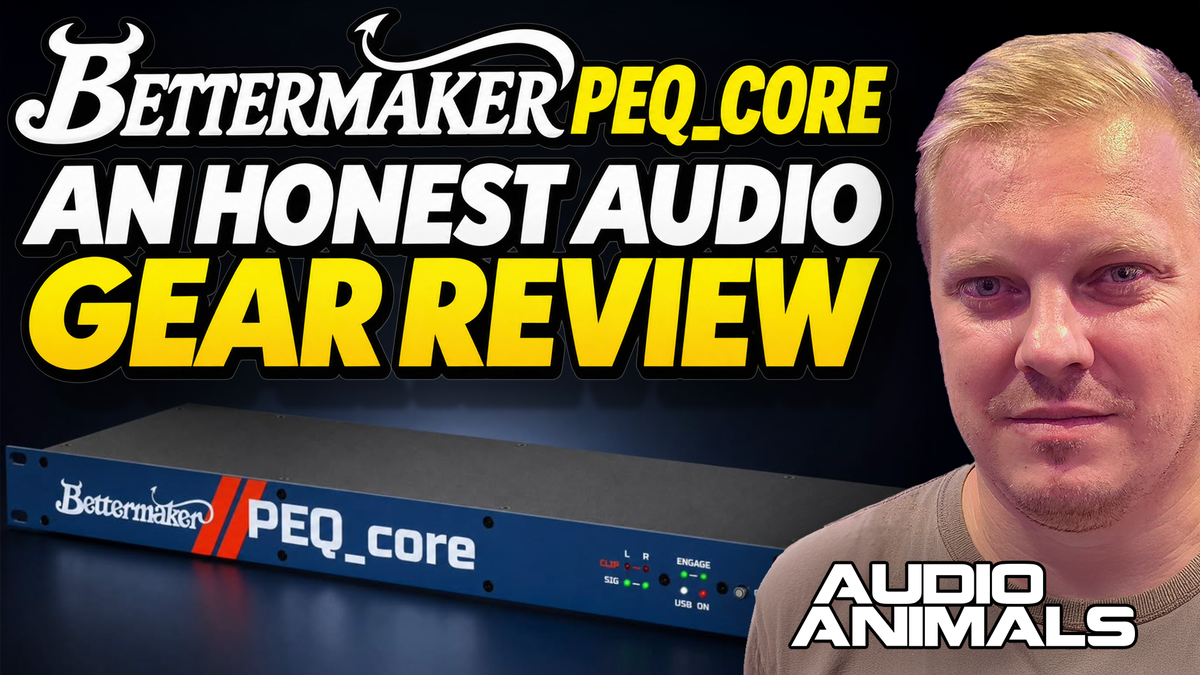
The Bettermaker PEQ Core is one of those pieces of equipment that makes you question how much you really need physical controls on your analogue hardware.
I've owned the Bettermaker PEQ Core for quite some time now, and I've had plenty of opportunities to put it through its paces. Having used it extensively in my studio, I think it's a fantastic piece of equipment, particularly considering its price.
Like all my Honest Audio Gear Reviews, this isn't about providing audio examples. I'm sharing my experience of actually owning and working with the equipment: what I like, what I don't like, and whether I think it's worth buying.
The PEQ Core takes the character of Bettermaker's Pultec-style passive EQs and puts it into a compact 1U unit, controlled entirely through software.
That approach won't appeal to everyone, but having used it for some time, I think Bettermaker has made an excellent decision.
Watch: Bettermaker PEQ Core – An Honest Audio Gear Review
How I Use the PEQ Core on My Mix Bus
When I'm mixing, the PEQ Core normally sits on my mix bus.
I absolutely love it in that position, particularly for what it does to the high frequencies.
A lot of people associate Pultec-style EQs with their low-frequency characteristics, and there's certainly plenty to like about the low end on this unit.
However, for me, the high-frequency section is where the PEQ Core really shines.
I can use the high-frequency attenuation to gently roll off some of the top end, shifting the overall tonal focus slightly lower without making the mix feel dull.
It's a subtle adjustment, but one that I find incredibly useful.
The high-frequency response is beautifully smooth, and it has that lovely character I associate with a good passive EQ.
“I love it on the mix bus. The high end is absolutely lovely and smooth.”
Does It Sound Like a Proper Pultec-Style EQ?
When I first saw the PEQ Core announced, my immediate reaction was that the price looked incredibly attractive.
However, that only matters if the equipment sounds good.
Fortunately, it does.
To my ears, the PEQ Core delivers exactly the type of sound I expect from Bettermaker's Pultec-style passive equalisation.
You get that familiar ability to shape the low frequencies with the characteristic Pultec-style curve.
You can also create that lovely, broad high-frequency lift that these types of equaliser are known for.
It's a very musical-sounding EQ, and I've found it useful for shaping the overall tonal balance of a mix.
I've always liked the sound of Bettermaker's passive EQ designs, and the PEQ Core continues that approach.
How Does It Compare with the Bettermaker VSPE?
I've always been a fan of the Bettermaker VSPE, particularly because of its low-frequency character.
The VSPE has a certain weight in the low end that I really enjoy. There's almost a box-like tonal character to it that sounds fantastic in the right circumstances.
I don't hear that same characteristic in the PEQ Core.
That isn't necessarily a criticism. They're different units, and the PEQ Core still delivers a lovely passive EQ sound.
The important point is that the PEQ Core retains the Pultec-style equalisation qualities that make Bettermaker's designs appealing.
I've also wondered how closely it compares with the passive equalisation available in Bettermaker's Mastering EQ.
They strike me as having a broadly similar character, although I haven't carried out a controlled comparison between them.
That's something I would like to explore in a separate video.
The £1,000 Price Is a Major Selling Point
One of the things I particularly like about the PEQ Core is Bettermaker's approach to pricing.
Their other passive EQ models sit at higher price points, with the valve-based VSPE costing considerably more.
Rather than simply offering another expensive unit, Bettermaker has removed the physical controls, housed the EQ in a compact 1U enclosure and offered it at approximately £1,000.
When I first saw that price, I thought it was exceptionally good, provided the sound quality lived up to expectations.
Having used the unit, I think it absolutely does.
For the quality of analogue equalisation you're getting, I think the PEQ Core represents excellent value.
The Lack of Physical Controls: Is It Really a Problem?
This is where I think the PEQ Core will divide opinion.
There are no conventional front-panel EQ controls. If you want to adjust the unit, you do it through Bettermaker's software plug-in.
For some engineers, that's going to be an immediate deal-breaker.
I understand why. There is something enjoyable about physically adjusting an analogue equaliser, particularly one with a Pultec-style design.
However, I don't personally see the lack of controls as a significant disadvantage.
In fact, with the way my studio now operates, I actually prefer software control.
If physical controls are essential to you, Bettermaker already offers alternatives.
The SPE version, for example, provides physical front-panel controls.
You'll spend more money, but you'll get the hands-on experience you're looking for.
That's why I don't think the absence of controls is a particularly fair criticism of the PEQ Core.
It's part of the reason the product can be offered at this price.
Why I've Changed My Mind About Software-Controlled Hardware
If you'd asked me about a unit like this eighteen months ago, I probably would have been against it.
I used to be extremely focused on having everything within physical reach.
In my previous studio, the equipment was arranged around me specifically so I could access the controls without leaving the listening position.
That made sense for the way I was working at the time.
However, the amount of analogue equipment we now have at Audio Animals makes that approach increasingly impractical.
There's simply too much gear to have everything positioned directly around me.
Some equipment is located to the side of the studio, while other processors sit in different racks around the room.
As a result, I've changed how I work.
I now prefer to control my analogue equipment from the computer while keeping my head in the monitoring sweet spot.
This allows me to make adjustments without constantly moving around the studio.
For critical listening, I find that particularly useful.
“I like to keep my head in the sweet spot and control my hardware through a plug-in.”
Plug-In Control Actually Gives You More Features
Something I think people overlook is that controlling hardware through software can give you advantages that aren't available from physical controls alone.
The PEQ Core is a good example.
Within the plug-in, you have visual feedback showing the EQ settings and how they're being adjusted.
You can work with the conventional controls, but you can also interact with the EQ graph itself.
For me, that's a genuinely useful way of working.
However, one of the biggest advantages is something much simpler: undo.
When you're adjusting a conventional analogue Pultec-style EQ, you don't have the same software-based undo functionality.
With the PEQ Core, you can experiment, make adjustments and undo changes within the supported software workflow.
That's extremely convenient, especially when working on complicated mixing sessions.
Digital Recall
Store and recall hardware settings through the associated plug-in, making it much easier to return to previous sessions.
Software-Based Adjustments
Adjust the analogue EQ from your listening position without reaching for physical controls on a hardware rack.
Additional Visual Feedback
Use the plug-in's graphical interface to understand and manipulate the EQ settings more intuitively.
The Biggest Concern: Long-Term Software Compatibility
If there is one legitimate concern with the PEQ Core, it's the reliance on software.
Because the unit doesn't have physical front-panel EQ controls, you need compatible software and a working connection to make adjustments.
That raises an obvious question: what happens if the software is no longer supported?
What happens if an operating system changes and Bettermaker stops updating the drivers or control software?
At that point, the unit could become difficult or impossible to control on a modern computer.
That's a genuine potential drawback, and I wouldn't pretend otherwise.
However, it's also important to consider the manufacturer's history of supporting its products.
In my experience, Bettermaker has demonstrated a willingness to maintain software compatibility for older equipment.
That gives me confidence in the PEQ Core.
Nobody can guarantee that a digitally controlled unit will remain compatible with every future operating system.
But I don't personally consider that uncertainty a reason to avoid buying it.
What Happens in Ten or Twenty Years?
People often ask me the same question about my studio, because so much of our analogue hardware is digitally recallable.
What happens in twenty years if the software stops being updated?
My view is fairly straightforward.
Technology will continue developing, and I wouldn't be surprised if future tools, potentially including AI, make maintaining or recreating old software considerably easier.
That's my expectation, not something anyone can guarantee.
More importantly, I think we sometimes spend too much time worrying about hypothetical problems decades into the future.
The PEQ Core costs approximately £1,000.
If I get ten years of professional use from a piece of equipment at that price, I would consider that excellent value.
Of course, I hope it lasts considerably longer, and I genuinely expect Bettermaker to keep supporting it.
But even if compatibility eventually becomes a problem, that doesn't erase the value of all the years I've used it.
There is also the possibility of maintaining an older compatible computer system specifically for legacy equipment.
That isn't necessarily ideal, but it's an option.
Should You Worry About Future Compatibility?
It's worth considering, particularly if you expect to keep your hardware for several decades.
A software-controlled analogue unit carries a different long-term risk from equipment with entirely physical controls.
However, that risk needs to be balanced against the benefits you're getting today: digital recall, convenient control, a compact design and a lower purchase price.
If the uncertainty concerns you, buy the SPE version with physical controls.
Personally, I'm comfortable with the trade-off.
Who Should Buy the Bettermaker PEQ Core?
I think the PEQ Core is particularly appealing to engineers who want the sound of an analogue Pultec-style EQ, but also want the convenience of working inside a DAW.
If you're comfortable adjusting your hardware through a plug-in, it's a very attractive option.
You get genuine analogue processing, complete with the tonal characteristics I enjoy, while retaining the convenience of software control.
In practical terms, it can feel similar to working with a plug-in, but the audio is being processed through the external analogue hardware.
For someone like me, operating a studio with a large amount of digitally controlled analogue equipment, that combination makes a lot of sense.
On the other hand, if you want to physically turn knobs on every piece of equipment, the PEQ Core probably isn't the right version for you.
That's not a criticism of the unit.
It's simply a question of choosing the right product for your workflow.
My Final Verdict: Is the Bettermaker PEQ Core Worth It?
I genuinely struggle to find much to criticise about the Bettermaker PEQ Core.
It sounds fantastic, particularly through its smooth high-frequency equalisation.
The low end is very good, and you get the familiar Pultec-style tonal shaping that makes this type of EQ so useful.
The software control works brilliantly for the way I operate my studio.
The digital recall is extremely convenient, and I particularly appreciate the additional visual feedback and control features.
Then there's the price.
At approximately £1,000, I think the PEQ Core is exceptionally good value for the quality of analogue EQ you're getting.
The only meaningful criticism I can make is its reliance on software, together with the absence of physical front-panel controls.
However, if those things are important to you, Bettermaker already offers alternatives.
For my workflow, the PEQ Core is exactly the sort of product I like seeing manufacturers develop.
It makes high-quality analogue processing available at a more accessible price without sacrificing the sound that makes the hardware desirable in the first place.
If you're looking for a great-sounding, digitally recallable, Pultec-style analogue EQ, and you're comfortable controlling it from a plug-in, I think the Bettermaker PEQ Core is an excellent option.

Leave a comment
This site is protected by hCaptcha and the hCaptcha Privacy Policy and Terms of Service apply.