

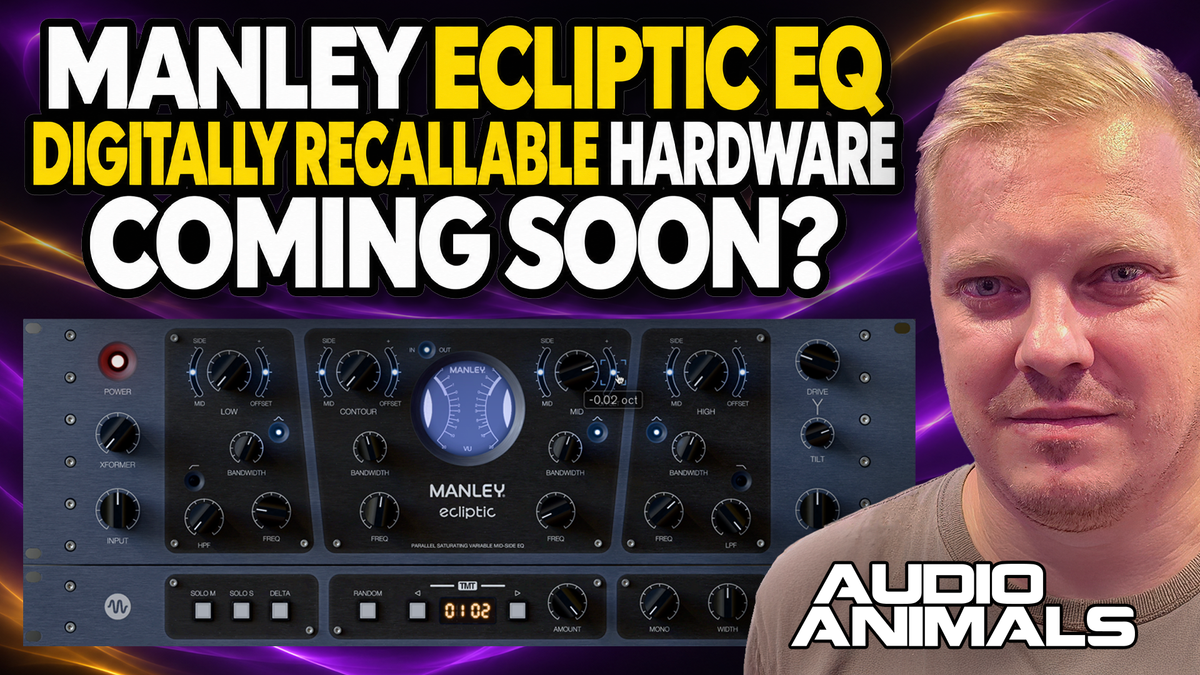
Do we really need another EQ plug-in? Probably not. But the Manley Ecliptic EQ from Plugin Alliance has a couple of features that make it genuinely interesting — and the possibility of seeing ideas like these in digitally recallable analogue hardware is what really caught my attention.
Anyone who follows Audio Animals knows that my studio is heavily focused on analogue equipment, so you might be wondering why I'm reviewing another plug-in. The answer is that I've heard talk of the Ecliptic potentially becoming a hardware product in the future. I don't know whether that will happen, but it's an exciting prospect.
There are already more EQ plug-ins available than most engineers could ever need. A lot of new releases don't offer much beyond what we already have. That's why I'm interested when a developer brings something different to the table — and in this case, the Mid/Side Focus and Offset features are worth exploring.
This isn't a conventional audio-example review. I want to explain what makes the controls interesting, how I might use them and why I'd love to see this approach in hardware.
Watch: Manley Ecliptic EQ — My Honest Thoughts
Why Am I Looking at Another EQ Plug-In?
To be completely honest, I don't need any more EQ plug-ins. I've already got everything I need to work. The market is full of equalisers, and another straightforward low, mid and high-frequency EQ wouldn't particularly excite me.
What does interest me is when somebody approaches equalisation differently. The Ecliptic has a few controls that make it easier to achieve particular results, and I think that's worthwhile.
The bigger attraction for me is the possibility of a digitally recallable hardware version. I've heard that this might be something Manley could explore. That's speculation at this stage, not a confirmed product, but I would love to see it happen.
Mid/Side Focus: The Feature That Stands Out
The Mid/Side Focus control is one of the cleverest parts of this EQ. It's a different way of adjusting the relationship between what sits in the centre of a stereo mix and what sits towards the sides.
Let's say I'm working on a vocal and want to bring a certain frequency range forward in the centre. Normally, I could boost that range in the Mid channel, then make a corresponding reduction in the Side channel. With this control, I can move in both directions using a single adjustment.
As I move the Focus control one way, the Mid response rises while the Side response falls. Move it the other way and the opposite happens. That opposing movement is what makes it interesting: it's not just adding more of a frequency, it's shifting the emphasis between the centre and the sides.
Imagine wanting to highlight the body of a vocal without emphasising the same range in the surrounding stereo information. Or perhaps you want to change where a high-frequency element appears to sit in the overall picture. The Focus control provides a quick way to experiment with those relationships, and the bandwidth control lets you be more specific.
You'll still have to listen carefully and find where it genuinely benefits a mix. It's not a control I'd use automatically on everything. But it gives me an interesting way to work.
“You're bringing the Mid up while pulling the Sides down. You're changing where the focus sits in the mix — all with one control.”
Couldn't I Do the Same Thing in FabFilter Pro-Q 4?
Yes, of course I could. That's the point I want to make. You can achieve a lot of these types of EQ moves in Pro-Q 4 by using separate Mid and Side bands.
But could I do it as quickly? Not necessarily. I'd have to set up the bands, make an adjustment in one channel and then make the corresponding adjustment in the other.
That reminds me of a Pultec-style EQ. You can recreate a similar response curve in a flexible digital equaliser, but getting to that particular curve can take more steps. On a Pultec-style design, the controls make it easy to reach that sound quickly.
The Ecliptic appeals to me for a similar reason. It's not necessarily doing something impossible elsewhere. It's presenting the process in a way that makes the result quicker and more intuitive to reach.
That matters. A good interface can influence the decisions you make, the speed you work at and the ideas you're willing to try.
The Offset Control: Another Interesting Approach
The second feature I really like is Offset. This allows the Mid and Side EQ responses to be shifted to different frequency positions, rather than keeping them centred at precisely the same point.
When you adjust the offset, you can see the responses move relative to one another. That opens up different ways of shifting the tonal emphasis between the centre and sides of a stereo signal.
Again, it's something you'd need to experiment with. I wouldn't suggest it will suddenly become an essential part of every mix, but I can absolutely imagine situations where it gives me a useful option.
What really gets me thinking is the prospect of doing something like this in the analogue domain. In software, these kinds of interactions are relatively straightforward to create. In digitally recallable analogue hardware, I'd find the concept considerably more exciting.
Opposing Mid/Side Moves
Emphasise a frequency range in the centre while reducing it in the sides, or reverse the relationship, through a single control.
Shift the Frequency Positions
Move the Mid and Side EQ responses apart to explore different tonal relationships across the stereo image.
Faster Than Building It Manually
Similar moves may be possible elsewhere, but the controls encourage quicker, more direct experimentation.
The Sound and the Xformer Control
Beyond the more unusual features, I also think the Ecliptic sounds good. I particularly like what the Xformer parameter brings to the sound.
I'm not going to fill this article with audio comparisons or pretend that everyone needs to buy another EQ. There are plenty of demonstrations available for anyone who wants to hear different settings.
What interests me is the overall combination: an EQ that sounds good, has its own character and includes controls that invite a different way of thinking about tonal balance.
Could This Become Digitally Recallable Manley Hardware?
This is the part I'm most excited about. If the Ecliptic's ideas eventually made their way into digitally recallable analogue hardware, I think it could be a very interesting product.
Imagine having the Mid/Side Focus control, the Offset feature and the tonal character of the design available as part of a hardware mastering chain. That's the possibility that makes me pay attention.
And then there's the bigger question: if Manley were to develop digitally recallable hardware around a product like this, what could that mean for the rest of its range? Could we one day see something like a digitally recallable Massive Passive?
I want to be absolutely clear that I'm talking about what I'd love to see, not announcing products that have been confirmed. But it's exciting to think about.
I'd genuinely encourage anyone who likes the idea to say so. If enough engineers express an interest in digitally recallable Manley hardware, perhaps that helps demonstrate that there's a market for it.
A Hardware Version Would Be Something Special
The Ecliptic is interesting as a plug-in in its own right. What excites me even more is the possibility of those controls being incorporated into a digitally recallable analogue EQ.
Important: The image below is a hardware concept/mock-up, not confirmation of an announced or forthcoming Manley product.

Where I Would Actually Use It
Vocals are one of the first things that come to mind. There are times when I want to pull a little more body out of a vocal in the centre while reducing some of that same frequency content in the sides.
Yes, I could set that up in Pro-Q 4. But the Ecliptic makes it straightforward to try, and that's precisely why I see value in it. When a control makes an idea easier to explore, I'm more likely to use it creatively.
I can see Offset having its place too, particularly when I want to explore a subtle change to how frequencies are distributed between Mid and Side. These aren't necessarily adjustments I'd use constantly. They're additional options for the occasions when they're useful.
My Final Thoughts on the Manley Ecliptic EQ
The Manley Ecliptic is another EQ plug-in in a market full of EQ plug-ins, but I don't think it's simply another copy of what we already have.
I like the sound, I like the Xformer control and, most importantly, I like the Mid/Side Focus and Offset features. They provide a slightly different, more direct way of approaching certain EQ decisions.
Do you need it? Not necessarily. If you're comfortable creating these sorts of moves in an EQ you already own, you can carry on doing that.
For me, though, the interesting part is that it's a new approach — and the potential for those ideas to translate into digitally recallable hardware is what really captures my imagination.
It's a good-sounding EQ with genuinely interesting controls. I'd love to see Manley take those ideas further.
Explore the Manley Ecliptic EQ
If you'd like to take a closer look at the plug-in, you can find it through the link below.
This is a tracked affiliate link.

Leave a comment
All comments are moderated before being published.
This site is protected by hCaptcha and the hCaptcha Privacy Policy and Terms of Service apply.