

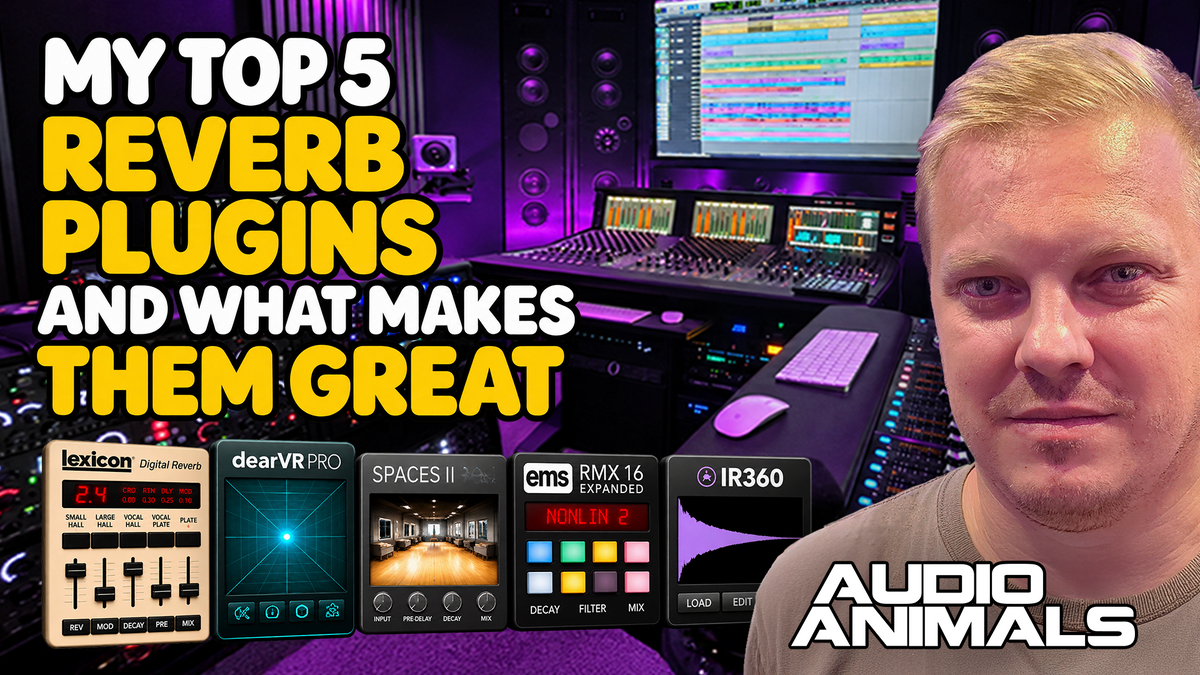
As a mixing engineer, I’m always looking for a great-sounding reverb that offers something different from what I already have in my arsenal. For me, reverbs need to sound natural. If I load a hall preset, I want it to come as close as possible to the sound of an instrument actually being played in a hall.
Control is important, too. Room size and decay time are essential; without them, a reverb can become a one-trick pony. A high-pass filter is useful for removing unwanted low-end rumble, although I often prefer to shape the reverb with a Cambridge EQ. Being able to control depth is just as important: it helps me place sounds convincingly in the space I’m creating.
Why I use different reverbs in the same mix
Different sources call for different spaces. A drum kit needs a different treatment from a string section, and sustained strings may need a completely different reverb from staccato strings. For drums, I often want the sound of a small live room with tight tails that don’t spill into the next hit. A long hall can easily make the same part muddy and unnatural.
I try to imagine the music being performed live in a room, even when the track is entirely electronic. Where is each instrument positioned? How far away is it? If I picture a horn section at the back of the room, I might sit it lower in the mix and give it more of that room’s reverb than an instrument positioned right at the front. Thinking this way creates a sense of depth that simple left-to-right panning cannot achieve.
These are the five reverb plugins I was reaching for when I originally wrote this article in 2018, and what made each one stand out.
Lexicon 224
My go-to reverb for that classic, lush sound.
The Universal Audio emulation of the Lexicon 224 is remarkably close to the original hardware. Having used both extensively, I found them very much alike. The 224 became a studio classic for good reason, and it was my first choice for a huge range of sounds.
This is probably the only reverb that makes me use the word lush. It really does describe its character. There’s a creamy quality to its vocal reverbs, particularly the vocal plate, that makes a voice sit beautifully in a mix.
It offers eight reverb programmes: two small halls, a large hall, vocal plate, chamber, percussion plate, room and constant-density plate. That might seem limited compared with plugins offering hundreds of presets, but each programme has a distinctive, recognisable Lexicon character. Quality matters far more than the number of options.

Dear Reality dearVR Pro
For placing a sound somewhere in a believable three-dimensional space.
dearVR Pro was unlike the conventional reverbs I was using at the time. It combines spatial positioning with virtual acoustics, allowing you to move a source around a listener — left, right, behind, above or below — and hear how the selected environment changes its character.
Imagine choosing a church and moving an instrument towards the back of it. The plugin doesn’t simply make that instrument quieter or more distant: it models the acoustic impression of the source being played from that position. That made it a genuinely useful tool for creating depth.
Instead of thinking about a mix as just left and right, it encouraged me to think about front, back, height and everything in between. That was what made it so exciting.

East West Spaces 2
For convincing recordings of real acoustic environments.
East West Spaces 2 is a convolution reverb with an enormous range of spaces to explore. Its impulse responses cover conventional rooms, churches and public buildings, alongside more unusual environments such as catacombs and train stations.
What impressed me most was the realism of the recorded spaces. There are multiple variations to choose from, so it’s possible to find a room that suits the source rather than trying to force one preset to work for everything.
The controls aren’t as extensive as those of some algorithmic reverbs, but there’s enough flexibility to adjust the sense of room size, decay and frequency balance. When I wanted the impression of an instrument actually being performed in a real space, this was a strong choice.

AMS RMX16 Expanded
A versatile all-rounder, especially on drums.
The AMS RMX16 Expanded was one of those reverbs I could reach for almost anywhere in a mix. Its expanded selection of programmes offered plenty of starting points, and with some tweaking I could usually find the sound I wanted.
I particularly liked it on drums. It has some excellent room-style treatments, including short, punchy sounds that can approach a slapback-delay effect. That makes it useful for adding character without washing the kit in a long reverb tail.
The plugin was designed to recreate the much-loved original AMS hardware and its algorithms. For anyone looking for one versatile, characterful reverb rather than a huge collection of specialised tools, it was a compelling option.

Waves IR-360 Convolution
My choice for working with unusual, custom impulse responses.
Last but by no means least is Waves IR-360. It came with a substantial impulse-response library, but that wasn’t the main reason I used it. The real attraction was the ability to load impulse responses I’d recorded myself over the years, including some used in our Kontakt sampler instruments.
It gives you useful control over room size and early and late reflections. I didn’t find its bundled library as inspiring as the spaces in East West Spaces 2, but the flexibility to use my own recordings more than made up for that.
Some of my favourite impulse responses came from strange environments — washing machines, filing cabinets and other places you wouldn’t normally associate with a reverb. For sound design, those unusual spaces can be far more interesting than another perfectly polished hall.

Which reverb is best?
There isn’t one reverb that does everything better than the rest. I reach for the Lexicon when I want that unmistakable classic character, the AMS for punchy drum treatments, Spaces 2 for realistic rooms, dearVR Pro for spatial depth, and IR-360 when I want to experiment with my own recorded spaces.
The important thing is to listen to what the track needs. Picture the room, decide where the instruments belong, and choose the reverb that helps tell that story.
Editor's note: This article preserves my original 2018 selection and perspective. Plugin versions, prices, compatibility and availability may have changed since publication.

Leave a comment
All comments are moderated before being published.
This site is protected by hCaptcha and the hCaptcha Privacy Policy and Terms of Service apply.