

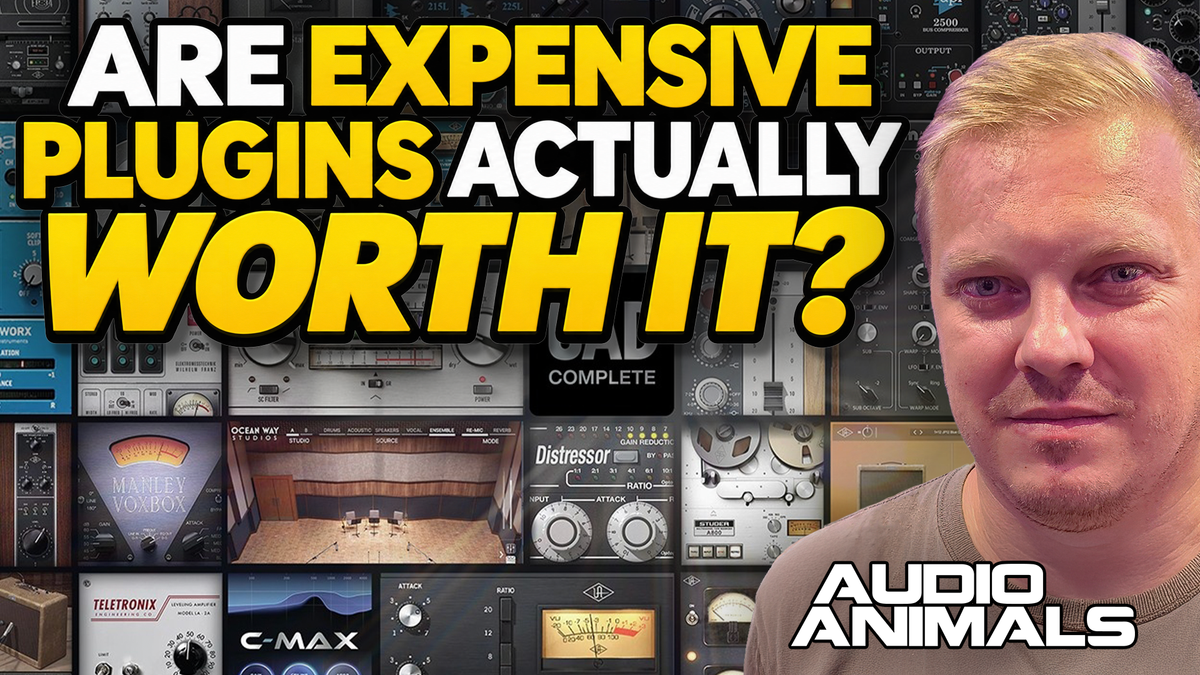
Can expensive audio plug-ins really make your mixes sound better? My honest answer is no. Spending £300 on a plug-in doesn't automatically mean you're getting a better sound than someone using an alternative that costs £29.
I think expensive plug-ins are increasingly becoming a thing of the past. When we're talking about individual EQs, compressors, saturation processors and other conventional audio effects, I find it difficult to justify some of the prices we've historically seen.
That doesn't mean expensive plug-ins are bad. Some are absolutely brilliant. But price alone tells you very little about the sound quality you're actually getting.
For me, the biggest factor in achieving a professional mix isn't how much you've spent on your plug-ins. It's the knowledge, experience and ability of the person using them.
Watch: Can Expensive Plugins Make Your Mix Sound Better?
When Did Audio Plug-ins Become So Expensive?
I remember when paying £300 for an individual audio plug-in wasn't particularly unusual. Universal Audio, for example, used to sell some of its plug-ins for considerable amounts of money.
I believe I paid somewhere around £349 for the UAD Ampex ATR-102 tape machine plug-in approximately 14 or 15 years ago.
Don't get me wrong. It's an incredible plug-in. It was excellent when I bought it, and I still think it's an excellent plug-in today.
But the market has changed enormously since then.
We now have access to an extraordinary range of high-quality processing tools, many of which can be purchased for relatively little money.
So when I see a conventional EQ, compressor or saturation plug-in advertised for £300, I do question whether that price is really justified in today's market.
Not because the plug-in is necessarily bad, but because there are so many excellent alternatives available for considerably less.
“Just because a plug-in costs £300 doesn't mean it's going to make your mix sound better.”
You Can Make an Incredible Mix With Affordable Plug-ins
I would argue that you could produce an absolutely incredible mix using a relatively small collection of good-quality plug-ins.
Take the FabFilter range, for example. I use a lot of their software myself, and it's an excellent example of how a collection of well-designed processors can cover almost everything you need.
You've got powerful EQ processing, compression, limiting, multiband dynamics, gating, reverb and delay.
Those tools cover an enormous amount of the processing that takes place during professional mixing and mastering.
Of course, you might want other plug-ins for particular sounds, effects or creative applications. There's nothing wrong with that.
But could someone produce a genuinely professional mix using those tools?
Absolutely.
And I don't believe that spending hundreds or thousands of pounds on additional plug-ins would automatically make that mix better.
Why Expensive Hardware and Expensive Plug-ins Aren't the Same Thing
There's an interesting distinction between hardware and software when we're talking about price.
With analogue hardware, a higher price can sometimes reflect the cost of the components used to manufacture the equipment.
Better transformers, more expensive electronic components, manufacturing quality and other physical elements can all contribute to the cost of a piece of hardware.
That doesn't automatically mean more expensive hardware sounds better, but there are genuine physical differences that may help explain the price.
With plug-ins, I don't think the relationship between price and sound quality works in quite the same way.
A plug-in is software. You're paying for the development, the algorithms, the features, the company's expertise and the product they've created.
All of those things have value. Developing good software takes time and knowledge.
But a £300 plug-in isn't inherently going to sound better than a £50 plug-in simply because it's more expensive.
That's the distinction I think people need to understand.
Don't Overlook the Plug-ins You Already Own
One of the best examples of this is the stock EQ that comes with Logic Pro.
I think Logic's EQ is genuinely very good.
It's a capable EQ that you can use to achieve excellent results, and it's already included with the software.
Does buying another EQ automatically mean you're going to improve your sound?
No. Not necessarily.
In fact, there's nothing wrong with using free or included plug-ins when they do what you need them to do.
My opinion of the stock plug-ins included with Pro Tools is rather different.
Considering how expensive Pro Tools is as a DAW, I've never been particularly impressed with a lot of its included processing.
That's my personal opinion, and other engineers will undoubtedly disagree.
But the important point is that something doesn't become a bad processor simply because it comes free with your DAW.
If it's a good EQ, it's a good EQ. The price doesn't change that.
A £29 Plug-in Can Still Be an Excellent Professional Tool
There's a tendency to associate price with quality. I'm guilty of it myself sometimes. You see two products, one considerably more expensive than the other, and instinctively assume the expensive one must be better.
Sometimes that assumption is correct. But it certainly isn't a reliable rule when choosing audio plug-ins.
If an affordable processor delivers the sound and functionality you need, there's no reason to dismiss it because of its price.
The Elysia Alpha Compressor Is a Perfect Example
Let's take the Elysia Alpha Compressor.
We have the hardware version at Audio Animals, which cost approximately £10,500.
The plug-in emulation can sometimes be found at a fraction of that price. I wouldn't be surprised to see it available for around £29 or £49 during a sale.
I haven't checked its current sale price, but the point is that you can obtain a very convincing emulation of an extremely expensive hardware compressor for relatively little money.
Now, I do hear a difference between the hardware and the plug-in.
That's one of the reasons I value owning and using the physical compressor.
But the plug-in is still exceptionally good.
And here's the important part: if you purchased that plug-in for £300 instead of £29, it wouldn't suddenly sound any better.
You're getting the same software, the same processing and the same sound.
The price you paid hasn't changed its quality.
The Psychology Behind Expensive Plug-in Pricing
I think the way plug-ins are priced and discounted has a significant influence on how consumers perceive them.
Imagine a company releases a new EQ for £300.
You look at it and think it's too expensive. You're not prepared to pay that much.
A few months later, that same plug-in goes on sale for £29.99.
Suddenly, it looks like an incredible deal.
You're getting what appears to be a premium £300 product at a fraction of its normal price.
Now imagine the company had originally launched that exact same plug-in at £29.99.
Would you look at it in the same way?
I don't think everyone would.
Some people would immediately categorise it as a cheap plug-in, even though nothing about the actual software had changed.
That's the psychology behind perceived value.
By establishing a high original price and later offering a large discount, companies can make the purchase feel much more attractive.
It's a marketing strategy that can work extremely well.
But it demonstrates why we shouldn't use the advertised price as a measure of sound quality.
“A £300 plug-in discounted to £29 isn't suddenly better than a plug-in that was £29 from the beginning.”
What Should an Audio Plug-in Actually Cost?
Personally, I think somewhere around £50 is a reasonable price point for many conventional audio plug-ins.
I'm talking about individual EQs, compressors, saturation processors and emulations of analogue equipment.
I'm not suggesting every piece of audio software should cost £50.
There are obvious exceptions.
Something like iZotope Ozone, for example, is a much more comprehensive collection of processing tools and functionality.
The same applies to certain specialist applications, including software designed for vocal tuning and other complex tasks.
Those products are offering something broader than a single conventional audio processor.
But when we're talking about another straightforward EQ, compressor or hardware emulation, I think the market has reached a point where extremely high prices are becoming harder to justify.
Especially when companies regularly discount those same products so dramatically.
Price Isn't Sound Quality
A more expensive plug-in doesn't automatically produce a better result than an affordable alternative.
The Engineer Matters Most
Knowing how, when and why to use a processor is more important than how much it costs.
Use What You Already Own
Before buying more plug-ins, consider whether your existing tools already do everything you need.
The Engineer Makes the Difference, Not the Plug-in Price
This is probably the most important part of the entire discussion.
You can give two engineers exactly the same collection of plug-ins and they'll produce completely different results.
The software hasn't changed.
What has changed is the person using it.
Their listening ability, understanding of EQ, compression, dynamics, balance and musical context all influence the result.
An experienced engineer using an affordable collection of processors can achieve outstanding results.
Someone with considerably less experience won't automatically produce the same quality simply because they've purchased the most expensive plug-ins available.
That's why I think the obsession with owning more and more software can sometimes become a distraction.
It's much more valuable to understand the tools you already have and learn how to get the most out of them.
Do We Really Need Any More Plug-ins?
Here's something that probably won't make me particularly popular with plug-in manufacturers.
I genuinely think that a lot of us already own everything we need.
If you sit down and look through your plug-in collection, how many EQs do you actually have?
How many compressors? How many saturation processors, reverbs, delays and limiters?
And how many of those are you genuinely using on a regular basis?
I suspect a lot of engineers and producers have far more software than they really need.
I'm in that position myself.
I haven't purchased a new plug-in in a long time, simply because I don't feel I need anything else.
I've got the tools I need to do my job.
Unless something comes along offering genuinely useful new functionality, I don't feel the need to keep buying another version of something I already own.
And I think more producers and engineers should consider taking that approach.
My Final Opinion: Expensive Plug-ins Won't Automatically Improve Your Mix
So, can expensive plug-ins make your mix sound better?
Not simply because they're expensive.
There are excellent high-priced plug-ins, just as there are excellent affordable and free alternatives.
What matters is whether a particular processor offers something useful for the work you're doing.
If a £300 plug-in gives you a feature, sound or workflow that genuinely improves your results, then you might consider it worthwhile.
But don't assume the price itself guarantees anything.
You can achieve incredible results with inexpensive software.
You can achieve incredible results with stock plug-ins.
And you can achieve disappointing results with the most expensive software available.
Ultimately, it comes down to the person using the tools.
My advice is simple: learn your existing plug-ins properly, understand what they're doing and only buy something new when you've identified a genuine need for it.
Great mixes come from great decisions, not expensive plug-in collections.

Leave a comment
All comments are moderated before being published.
This site is protected by hCaptcha and the hCaptcha Privacy Policy and Terms of Service apply.