

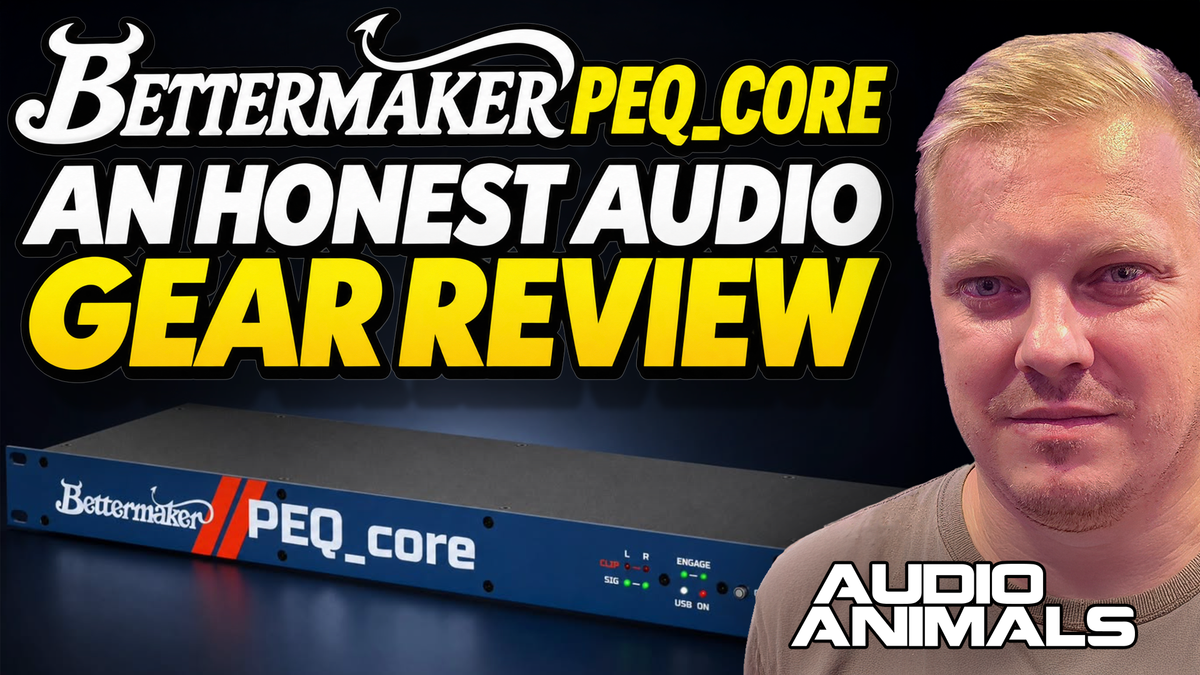
The Bettermaker PEQ Core takes a very different approach to analogue EQ: put the sound of a Pultec-style passive equaliser into a compact 1U unit, remove the front-panel controls and operate everything from a plug-in. Personally, I think it's a brilliant idea.
When I first heard it would cost around £1,000, my reaction was that the pricing looked incredibly good — provided it sounded great. Having used it, I can say that it does. It delivers the sort of passive, Pultec-style character I want from a Bettermaker EQ, with the benefits of digital control and recall.
What interests me just as much as the sound, though, is what the PEQ Core says about the direction of professional analogue hardware. A year and a half ago, I would have been against a unit with no physical controls. Now I actually prefer working that way.
Why I like the PEQ Core
Watch: Bettermaker PEQ Core — My Honest Opinion
A Pultec-Style EQ Without Front-Panel Controls
The idea is straightforward. Bettermaker has taken the sort of passive EQ sound I associate with its other Pultec-style designs, put it into a simpler 1U hardware unit and made the controls accessible through software.
I know some people will dislike the lack of knobs and switches, and I understand that. If having physical controls is important to you, Bettermaker offers versions with front-panel control, including the SPE.
This is a different proposition: a lower-cost way of getting the analogue sound while operating it from your computer.
At around £1,000, I think that makes a great deal of sense. There is no need to pretend the PEQ Core is something it isn't.
How Does the Bettermaker PEQ Core Sound?
For me, the most important thing is that the PEQ Core sounds genuinely good.
It has that familiar Pultec-style character: you can shape the low end with the lovely broad curves these equalisers are known for, and you can add that pleasing lift in the top end.
I've always liked the sound of Bettermaker's passive EQ designs.
The older VSPE, in particular, had a low-end weight — almost a box-like character — that I loved.
I don't hear that same quality in the PEQ Core, but what I do hear is a very good passive EQ with a sound I would happily use.
There is also passive EQ functionality within Bettermaker's Mastering EQ.
I suspect there could be similarities between the designs, but I haven't carried out a direct comparison, so I'm not claiming they sound identical.
That's something I'd be interested in testing separately.
Why I've Changed My Mind About Software-Controlled Hardware
If you'd asked me eighteen months ago whether I wanted analogue hardware without any controls on its front panel, I would probably have said no.
I always liked having my equipment within arm's reach so I could make adjustments by hand.
In my previous studio, everything was built around my listening position for exactly that reason.
I wanted to reach every piece of equipment from the chair.
The reality of the current Audio Animals studio is different.
We have so much equipment that it simply cannot all sit around me.
Some is to one side, some to the other, and there are consoles to work around as well.
Stretching over to adjust equipment isn't always the best way to work.
These days, I like sitting in front of my keyboard and mouse, keeping my head in the monitoring sweet spot and making adjustments through the plug-in.
I can remain focused on what I'm hearing instead of moving around the room to reach controls.
“I used to want every control within arm's reach. Now I'd rather stay in the sweet spot and control the hardware from the plug-in.”
The Plug-in Gives You More Than Just Remote Control
One of the biggest advantages of the software interface is that it can provide more visual information and control than a traditional analogue front panel.
With the PEQ Core, I can work with the EQ controls through the plug-in and use its graphical display to see what I'm doing.
Then there are the everyday workflow features that are easy to take for granted when you work in a DAW.
Undo, for example.
Being able to reverse an adjustment is incredibly useful, and it simply isn't something you get from a conventional, non-recallable Pultec-style unit.
For anyone moving between multiple sessions, the ability to recall settings matters enormously.
It's one of the reasons I've built so much digitally recallable analogue equipment into our studio.
Repeatable Sessions
Return to a project without manually reconstructing every hardware setting.
Better Feedback
Work with an EQ graph and software controls while listening from the sweet spot.
Quick Revisions
Reverse an adjustment without having to remember the exact previous position of a physical control.
What Happens If the Software Stops Being Supported?
The most reasonable criticism of the PEQ Core is its reliance on software.
If a future operating system or DAW no longer supports the required connection, driver or control plug-in, you could lose the ability to operate the unit as intended.
Without front-panel controls, that risk matters more.
I'm not dismissing that concern. Compatibility is a real consideration whenever you buy digitally controlled hardware.
But I also look at the manufacturer's history.
In my experience, Bettermaker has kept support available for older digitally controlled products for many years, and that gives me confidence.
Some people ask me what happens in twenty years if the software is no longer maintained.
My personal view is that technology will have moved on enormously by then, and I am optimistic that solutions may exist.
I wouldn't treat future AI recreation of control software as a guarantee, though. It is simply one reason I'm less worried about the long term than some people are.
There is also the practical option of keeping a compatible system available for older equipment.
That isn't ideal for everyone, but it is an option.
Would I Still Buy It Knowing That Risk?
Yes. At around £1,000, even if I got ten good years of reliable use from the PEQ Core, I would feel I'd had excellent value from it.
And to be clear, I don't expect it to become unusable after ten years — that's simply how I weigh the risk against the price.
If you intend to keep a piece of equipment operating independently for decades, the software dependency may be a reason to choose a model with physical controls.
If you value recall and modern integration, the PEQ Core makes a compelling case.
Is the Bettermaker PEQ Core Worth £1,000?
In my opinion, absolutely.
It's a well-priced way to bring the sound of a high-quality analogue, Pultec-style EQ into a digitally recallable studio workflow.
The controls work well, recall works well, and I enjoy using it.
What I really like is that you get the convenience and familiarity of operating a plug-in while the actual processing happens in the hardware.
For the way I work today, that's a benefit rather than a compromise.
Some people will want a front panel full of knobs.
That's completely fair, and those people should buy a different version.
But removing those controls to achieve this price point is a trade-off I'm more than happy to make.
My Final Verdict on the PEQ Core
I love this unit.
It sounds great, works brilliantly and fits the way I now prefer to run my studio.
At around £1,000, I find it difficult to criticise the value.
The main drawback is the dependence on software for control.
I accept that risk, and I have confidence in Bettermaker's continued support, although nobody can guarantee compatibility indefinitely.
If you're looking for a good-sounding, digitally recallable analogue EQ and you're happy to use plug-in controls, the Bettermaker PEQ Core is a very good option.
If you need physical controls, buy the version that has them. It's as simple as that.