


How close can a plugin get to a £6,000 analogue EQ? In this comparison, I put the Black Box Analog Design HG-Q hardware directly against its plugin counterpart to hear just how much of the analogue sound translates into software.
For this comparison, both the hardware and plugin versions have been passed through the same converters, helping to create a fairer test and allowing me to concentrate on the differences between the two processors.
To my ears, there is a substantial difference. The plugin stands up remarkably well against an expensive piece of analogue hardware, but the biggest distinction becomes apparent when listening to the way the hardware saturates and adds harmonic character.
In the video below, I compare the two directly so you can hear the differences and decide for yourself.
In this comparison:
Black Box HG-Q Hardware vs Plugin
Hardware versus plugin comparisons can be difficult to judge fairly, particularly when the analogue version has to pass through additional conversion while the plugin remains entirely inside the DAW.
For this test, I've passed both versions through the converters. This helps reduce that particular variable and gives us a more useful comparison of the processing itself.
The plugin does an impressive job, especially when you consider that it's being compared with a hardware equaliser costing around £6,000. However, to my ears, the difference becomes much clearer when you focus on the saturation and harmonic character rather than simply the EQ curves.
For me, the biggest difference isn't simply the EQ. It's the way the hardware saturates, adds density and changes the overall character of the audio.
Watch the Hardware vs Plugin Comparison
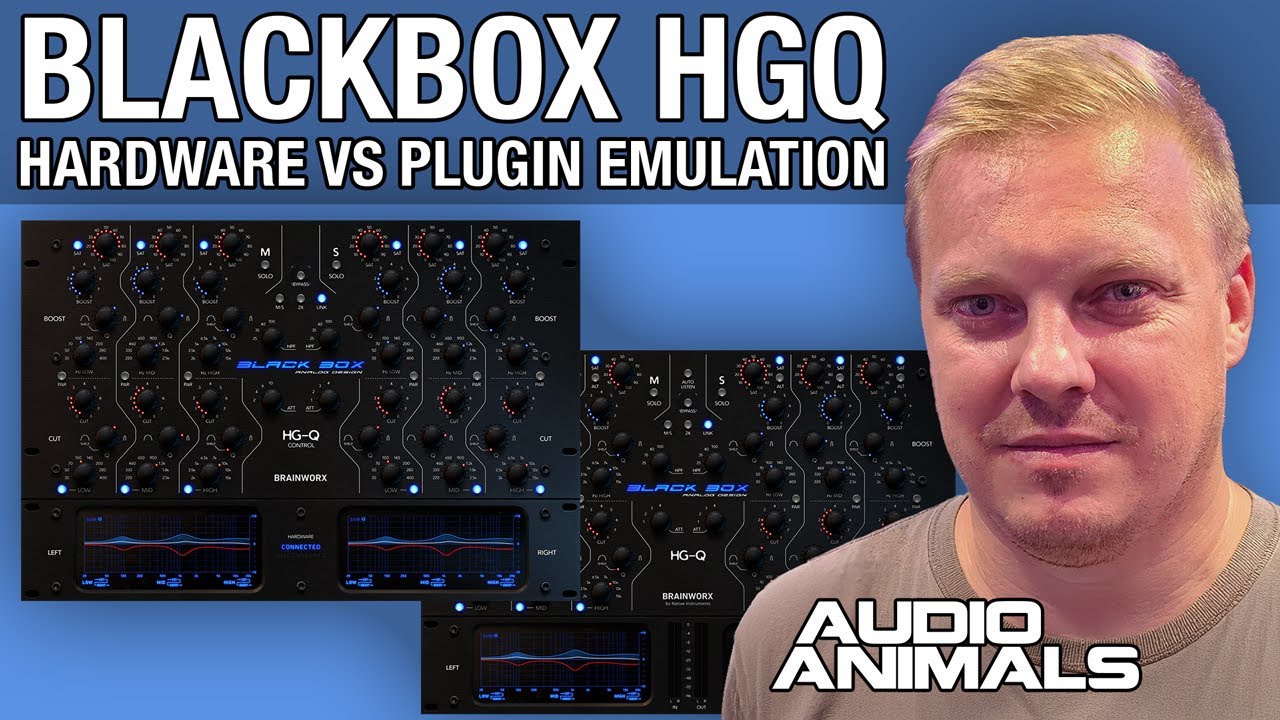
Black Box Analog Design HG-Q Hardware
The Black Box Analog Design HG-Q is a 3U boutique analogue equaliser and saturator designed to combine detailed frequency shaping with the harmonic character of valve-driven analogue circuitry.
Rather than treating EQ and saturation as completely separate processes, the HG-Q is designed so that tonal shaping and harmonic enhancement can interact. This allows it to move from relatively subtle mastering-style adjustments through to much more obvious colour and saturation.
Its six independent bands per channel provide extensive control over the frequency spectrum, while the analogue circuitry adds another dimension to the processing beyond the EQ changes themselves.

Black Box Analog Design HG-Q Hardware
The HG-Q hardware is available from professional audio retailers in both the UK and USA.
Black Box HG-Q Plugin
The Black Box HG-Q plugin brings the same overall approach into a software environment, providing the convenience of instant recall and in-the-box processing while modelling the behaviour and tonal character of the hardware.
It also expands the workflow with features that are naturally easier to implement in software, including a built-in spectrum analyser and an extended control view for more detailed adjustment.
In isolation, the plugin sounds extremely capable. The more revealing test is switching directly between it and the analogue hardware, particularly when listening to the saturation and harmonic behaviour.

Black Box HG-Q Plugin
If you want the HG-Q sound and workflow entirely inside your DAW, the software version is available from Plugin Alliance.
What Am I Listening For?
When comparing the hardware and plugin, I'm not only listening for differences in frequency balance. If both versions are performing broadly similar EQ moves, the more interesting question is what happens to the character of the audio around those changes.
I'm listening to the density of the low end, the presentation of the midrange, the openness of the top end and, most importantly in this comparison, the way each version responds when saturation becomes part of the sound.
To me, this is where the hardware begins to separate itself. The plugin can get surprisingly close in terms of overall tonal shaping, but I hear a more convincing sense of saturation and analogue character from the physical unit.
About the Black Box HG-Q
At the heart of the HG-Q is an analogue topology built around six independent frequency bands per channel. Its design allows frequencies to be cut and boosted in ways that create interactions between the bands, giving engineers considerable control over both tonal balance and the character of the processed signal.
The valve-driven saturation stages add another layer to the processing. Rather than using the HG-Q purely as a corrective equaliser, the hardware can be used to introduce harmonic density, energy and colour while shaping the frequency response at the same time.
This combination makes the HG-Q particularly interesting for mixing and mastering, where relatively small changes in tone and harmonic content can have a significant effect on the finished sound.
Key Features
Six EQ Bands
Six independent frequency bands per channel provide extensive control over tonal balance and frequency shaping.
Valve Saturation
Tube-driven saturation adds harmonic content, density and analogue character alongside the EQ processing.
Flexible Operation
Stereo, dual-mono and Mid/Side operating modes allow the HG-Q to adapt to different mixing and mastering workflows.
2X Mode
2X mode extends the EQ range, allowing boosts and cuts of up to 16 dB for more dramatic processing.
Analogue EQ and Saturation
One of the more interesting aspects of the HG-Q is the interaction between its EQ bands. Because the bands don't simply operate as completely isolated controls, combinations of boosts and cuts can create more complex tonal results.
This gives the processor a creative element beyond conventional equalisation. Series and parallel configurations can be used to shape the response in different ways, while the saturation circuitry adds harmonic content as the signal is processed.
In practical use, this means the HG-Q can move between subtle tonal refinement and much more obvious sonic transformation depending on how hard it is driven.
The HG-Q is as much about how the analogue circuitry responds to the signal as it is about the frequencies being boosted or cut.
Built for Modern Workflows
Although the HG-Q is fundamentally an analogue processor, it has been designed to integrate into modern studio workflows rather than operate as a completely isolated piece of outboard equipment.
Its plugin counterpart can be used to control the hardware remotely, combining physical analogue processing with the convenience of software-based control.
The plugin can also be used independently as a modelled software version of the processor, making it possible to work with the HG-Q approach even when the hardware isn't available.
Flexible Processing Modes
Stereo
Process the stereo signal as a complete mix, making this mode particularly useful for mix-bus and mastering applications.
Dual Mono
Independent channel operation provides greater flexibility when processing separate mono sources or channels.
Mid/Side
Mid/Side processing allows the centre and sides of a stereo signal to be shaped independently.
Hardware Design and Construction
The HG-Q is housed in a 3U rackmount chassis designed for professional studio use. Its front panel provides direct access to the processor's EQ, saturation and operating controls, with visual feedback helping make settings easier to understand during a session.
The combination of analogue processing, valve saturation and digital integration is central to the design. Rather than choosing between a traditional analogue workflow and modern software control, the HG-Q is designed to bring the two together.
Hardware or Plugin?
The plugin is impressive, particularly when you consider the enormous difference in cost and the convenience of being able to use multiple instances directly inside a DAW.
For EQ shaping alone, it demonstrates just how capable modern analogue modelling has become. However, in this comparison I hear a more obvious difference once the saturation and harmonic behaviour become part of the equation.
To my ears, the hardware produces the more convincing result. There is something about the way the physical analogue circuitry saturates and adds character that I don't hear to the same extent from the plugin.
That doesn't make the plugin any less useful. The important question is whether the difference is significant enough for your workflow to justify the cost and practical considerations of the hardware.
Hear the Difference for Yourself
Watch the full comparison above and listen to the Black Box HG-Q hardware and plugin side by side. Pay particular attention to the saturation, density and harmonic character rather than concentrating solely on the EQ balance.