


Audio Animals has grown from a mixing and mastering studio founded in 2012 into a multi-studio facility built around analogue hardware, Dolby Atmos and a comprehensive Dante audio network.
Founded by Paul Ashmore and Nick Burchall, Audio Animals works across music, film, animation and a wide range of professional audio projects. The studios combine high-end analogue equipment with modern digital workflows, recall systems and immersive monitoring.
Dante now plays a major role in connecting the facility, allowing large numbers of audio channels to move between computers, interfaces, converters and individual studios without the need for extensive analogue cabling.
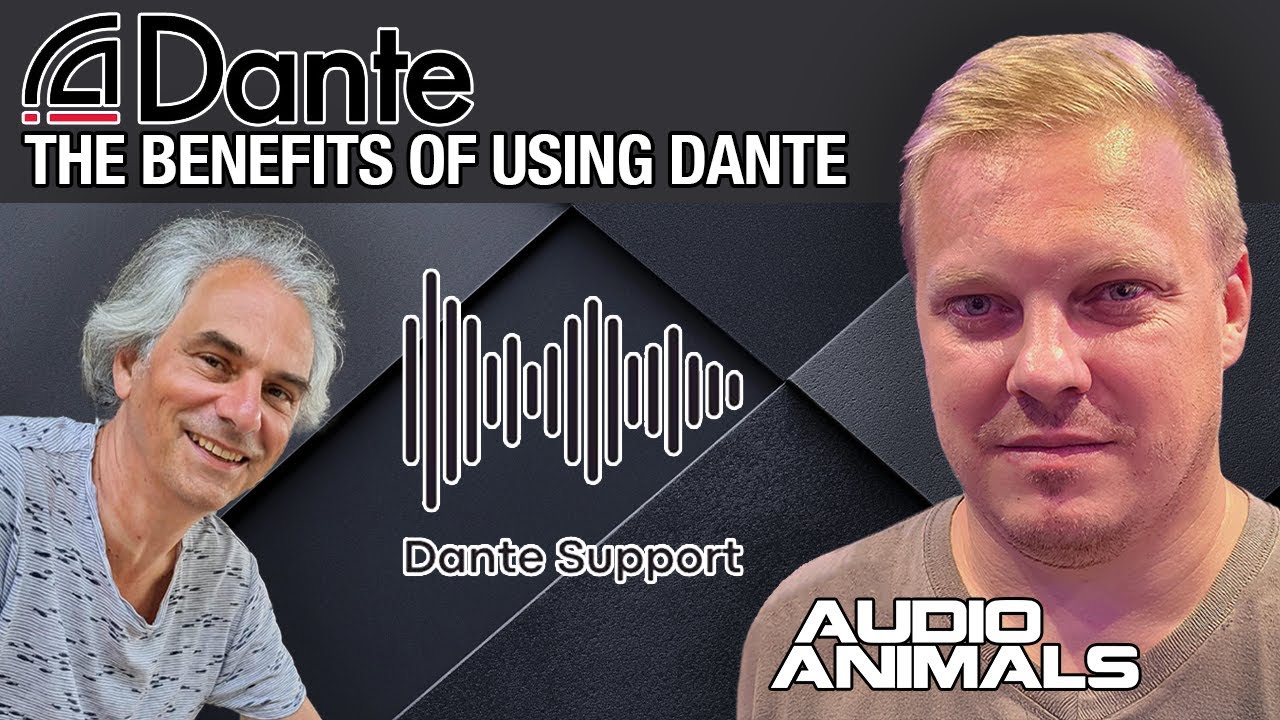
After a tour of the studios and some critical listening, Dante Support sat down with Paul Ashmore to discuss how Dante became part of the Audio Animals workflow and how the system is used today.
Audio Animals Dante network:
Watch the Full Dante Interview
Inside Studio B
Paul's Studio B is Dolby Atmos certified and built around Pro Tools with an Avid S4 control surface. Although the studio makes extensive use of digital routing and networking, analogue hardware remains an important part of the mixing and mastering workflow.
The studio houses an extensive collection of high-end and boutique analogue equipment, with an increasing focus on digitally recallable analogue hardware for mixing.
Monitoring is provided by a PMC 9.1.4 system using CI140, CI60 and CI30 loudspeakers.
How Did You Get Into Dante?
“When we started working with Dolby Atmos, we needed to send audio from the main DAW into a separate renderer computer. That meant routing up to 128 channels from one computer to another.”
“The logical way to achieve that was Dante. Trying to make the same connection using analogue audio would have required a huge amount of cabling and hardware. With Dante, all of those channels can travel through network cabling.”
The original system used Dante Virtual Soundcard on the DAW computer to route audio to the Dolby Atmos renderer. At the time, the required workflow using DVS was limited to 48 kHz, so the studio subsequently moved towards a hardware-based Dante infrastructure capable of supporting its higher sample-rate requirements.
Where Is Dante Used Today?
“At interface level, everything is connected through Dante. We use it to exchange audio between computers, audio interfaces and all three studios.”
“I can track something in Studio C and record it directly into Studio B. Without Dante, you would need large and expensive analogue cable runs going backwards and forwards between the studios.”
Computer Audio
Dante allows high channel-count audio to move between the studio computers and the wider network without traditional point-to-point analogue connections.
Audio Interfaces
The studio interfaces and converters form part of the Dante network, making audio available throughout the facility.
Studio-to-Studio Routing
Audio can be routed between the three Audio Animals studios, allowing one room to record, monitor or access sources located elsewhere in the facility.
Analogue Hardware
Analogue outboard equipment is also integrated into the Dante infrastructure, making it technically possible to access hardware located in another studio.
Dante & Trinnov Monitoring
Another important part of the system is the connection to Trinnov room correction.
By routing digitally through Dante, Audio Animals can integrate the Trinnov monitoring processor without introducing an unnecessary additional DA/AD conversion into the signal path.
Dante Hardware at Audio Animals
Ferrofish Pulse
Ferrofish Pulse converters are used within the mixing setup to connect analogue equipment with the digital Dante environment.
Burl Converters
Burl converters are used within the mastering chain, connected to the Dante network through an external AES-to-Dante interface.
Avid MTRX
An Avid MTRX forms an important part of the monitoring infrastructure and integrates with the wider Dante-based studio system.
Managing the Dante Network
Audio Animals manages its network using Dante Controller, Audinate's software for configuring and routing Dante-enabled devices.
“The first time I opened Dante Controller I thought, ‘Oh my God, what am I looking at?’ There were so many options and possibilities.”
“After about a week of playing around with it, I realised the software is actually very easy to understand and configure.”
The original Dante system was installed and commissioned by UK pro-audio specialist SX Pro, but Paul found that one of the most effective ways to understand the system was to remove the existing routing and rebuild it himself.
“The best way to learn Dante is to un-route the system and then bring it all back yourself. Rebuilding the routing helped me understand how the technology actually works.”
“Once everything is configured, you don't really need to touch it very often. It's just there. Most of the time you're only making the occasional instant routing change.”
What Do You Appreciate Most About Dante?
“What I appreciate most about Dante is that I have far fewer cables. Large numbers of audio channels can run backwards and forwards through the network without any loss of audio quality.”
“It makes life much easier and saves a huge amount of physical cabling and cost. Good analogue cables are expensive.”
High Channel Counts
Large numbers of channels can be transported around the studio infrastructure without requiring an equivalent number of individual analogue cable runs.
Less Cabling
Network audio dramatically reduces the amount of physical audio cabling required throughout a multi-room facility.
Digital Audio Routing
Audio Animals' Dante network operates at 96 kHz / 24-bit, allowing high-resolution digital audio to move throughout the facility.
What Would You Like to See Next?
“I want to see a 500 Series chassis with a Dante connection. You could buy the chassis, connect it directly to the Dante network and suddenly all of your 500 Series analogue equipment becomes accessible from the network.”
A Dante-enabled 500 Series chassis could provide an interesting bridge between networked audio and modular analogue processing, allowing traditional analogue equipment to become far more flexible within modern multi-room studio environments.
Dante at Audio Animals
Dante has become an integral part of the Audio Animals studio infrastructure, connecting computers, converters, monitoring systems, analogue equipment and multiple studios through a single networked environment.
What originally began as a practical solution for transporting a large number of channels between a Pro Tools system and Dolby Atmos renderer has developed into the backbone of the studio's audio routing.
For a facility combining high-end analogue equipment with Dolby Atmos, digital recall and multiple interconnected rooms, Dante provides the flexibility to move audio around the studios quickly while dramatically reducing the amount of physical cabling required.