


How close can a plugin get to the analogue hardware that inspired it? In this comparison, I put the IGS Audio 825EQ hardware against the Lindell Audio EQ825 plugin to hear how the two approaches compare.
The IGS 825EQ and Lindell Audio EQ825 aren't direct emulations of one another, so this isn't intended to be a perfectly controlled hardware-versus-software shootout. However, both are based around the same style of equaliser design and aim to deliver a very similar approach to tonal shaping.
That makes the comparison particularly interesting. Rather than asking whether one is simply better than the other, I wanted to hear how much of the character, tone and behaviour associated with this type of analogue EQ can be captured in software.
In the video below, I compare the two directly and listen to how they respond when used in a real-world mastering context.
In this comparison:
IGS 825EQ Hardware vs Lindell EQ825 Plugin
Hardware and plugin comparisons are always interesting, but they need to be viewed in context. In this case, the Lindell Audio EQ825 isn't intended to be a direct component-for-component emulation of the IGS 825EQ.
What makes the comparison worthwhile is that both processors draw from the same broad EQ concept and are designed to achieve a very similar style of musical equalisation.
That gives us an opportunity to listen beyond simple frequency changes and concentrate on the differences in tone, depth, character and overall presentation.
This isn't about proving that hardware or software is better. It's about hearing how two processors built around a similar idea behave when they're used on the same material.
Watch the Hardware vs Plugin Comparison
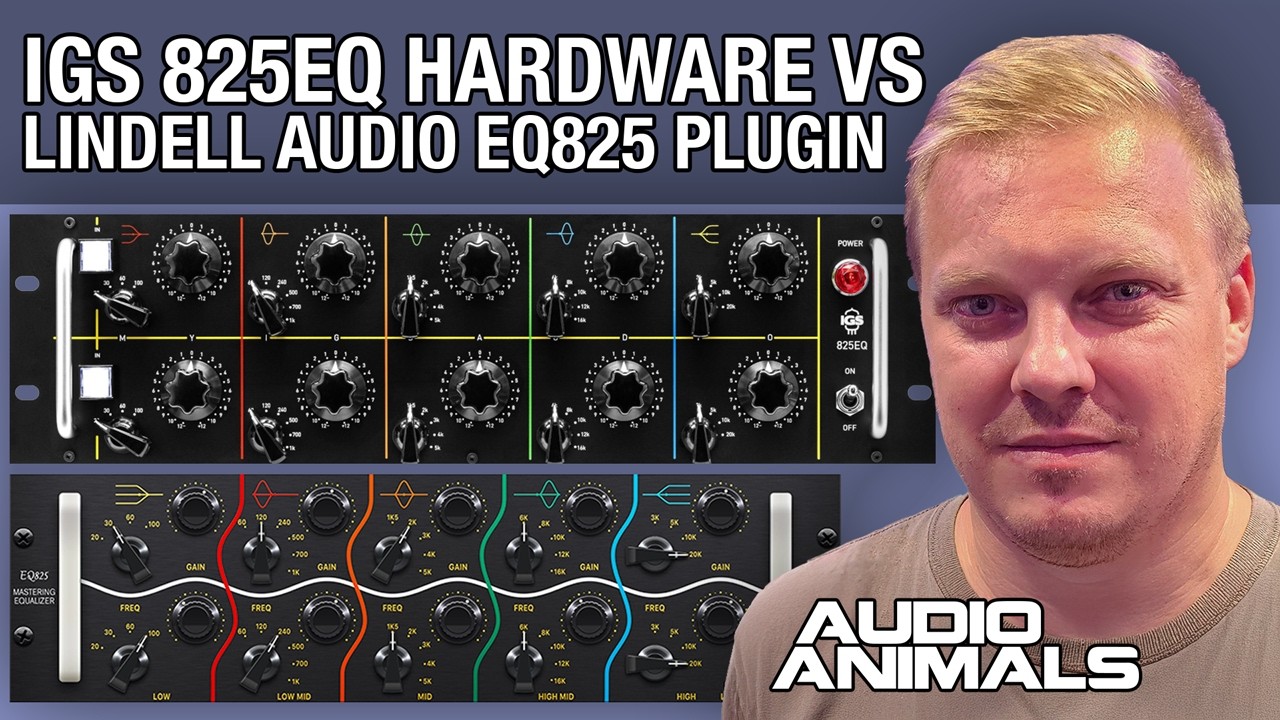
IGS Audio 825EQ Hardware
The IGS Audio 825EQ is a stereo analogue equaliser designed to combine precise tonal control with the character of transformers, inductors and tubes.
Rather than being a purely transparent EQ, its analogue signal path is part of the appeal. The transformers and tube stages contribute to the overall character of the processor, allowing the 825EQ to shape tone while also adding the depth and texture associated with analogue processing.
Its stepped controls are particularly useful for mastering, where repeatability and accurate left/right settings are important.

IGS Audio 825EQ
If you're looking for the hardware version, the IGS 825EQ is available from professional audio retailers in the UK.
Lindell Audio EQ825 Plugin
The Lindell Audio EQ825 takes this style of equalisation into the plugin world, providing a software alternative for engineers who want access to a similar approach without adding another piece of analogue hardware to their studio.
The important distinction is that I'm not treating the plugin as a direct digital clone of the IGS unit. They are different products, and differences between them are to be expected.
What interests me is how similar the overall result can become when the two are used with comparable settings and the same musical objective.

Lindell Audio EQ825 Plugin
The Lindell Audio EQ825 provides a software-based alternative for engineers who want this style of EQ processing entirely inside the DAW.
Hardware vs Plugin: What Am I Listening For?
When comparing the two processors, I'm interested in more than whether a boost or cut produces approximately the same tonal balance.
I'm listening to how the low end changes, how the midrange is presented, how the upper frequencies open up and whether either version introduces an additional sense of depth, density or character.
These differences can sometimes be relatively subtle, particularly when the processors are being used for mastering rather than extreme sound design. That is exactly why comparisons like this can be useful.
It also makes this a more realistic test of how the two products might actually be used in a professional workflow.
About the IGS Audio 825EQ
The IGS 825EQ is designed around the idea that an equaliser can do more than simply change frequency balance. Its inductors, transformers and tube stages all form part of the analogue signal path and contribute to the way the processor sounds.
This gives the 825EQ the ability to combine precise EQ adjustments with additional analogue character, making it particularly well suited to applications where tonal shaping and colour are equally important.
The unit is housed in a 3U 19-inch rackmount chassis and uses stepped controls designed to make precise settings repeatable. That is especially valuable in mastering, where small changes can have a significant effect on the finished result.
The appeal of the 825EQ isn't simply the frequencies you can boost or cut. The transformers, inductors and tubes are part of the sound of the unit itself.
Designed for Mastering Precision
One of the most important aspects of the 825EQ is its stepped control system. The unit uses 24-position ELMA switches, giving the engineer repeatable settings rather than continuously variable controls.
For mastering work, that precision is particularly useful. Small EQ adjustments can be recreated accurately, and matching settings across channels becomes considerably easier.
The EQ provides a Q range from 0.3 to 6 and a boost/cut range of ±12 dB, giving it enough flexibility to move between broad tonal shaping and more focused frequency adjustments.
Transformers, Tubes and Analogue Character
The IGS 825EQ uses transformer-balanced inputs and outputs, with UTM transformers forming part of its analogue design.
An important characteristic of the unit is that bypass doesn't completely remove the analogue electronics from the signal path. The signal continues to pass through the transformers and tubes, meaning the analogue stages remain part of the overall sonic character.
Each channel uses three ECC88 tubes, giving six tubes across the stereo unit. Compatible alternatives include E88CC, 6N23P and 6N1P-EV tube sets, allowing different tube options to be used within the design.
Key Features
Q Factor
Adjustable Q range from 0.3 to 6, allowing broad musical shaping or more focused EQ adjustments.
Boost & Cut
Up to ±12 dB of boost or cut provides a wide range of tonal adjustment.
Stepped Controls
24-position ELMA switches provide precise and repeatable control for mastering applications.
Tube Design
Six tubes are used across the stereo unit, with three tube stages per channel.
Input & Output
Input
Balanced XLR input with a stated 10 kΩ input impedance.
Output
Balanced XLR output with a stated 600 Ω output impedance.
Transformers
UTM transformers are used at the input and output as part of the analogue signal path.
Technical Performance
Frequency Response
10 Hz – 50 kHz with a stated tolerance of ±0.3 dB.
Signal-to-Noise
Stated signal-to-noise ratio of 87 dB.
THD+N
Stated THD+N performance of less than 0.2% across the specified measurement range.
Crosstalk
Stated crosstalk specification of 103 dB.
Compatible Tube Sets
The 825EQ can use a set of six ECC88, E88CC, 6N23P or 6N1P-EV tubes. This gives the hardware a genuine valve-based analogue stage rather than relying solely on EQ circuitry to create its character.
Hardware or Plugin?
The interesting part of this comparison isn't necessarily finding a definitive winner. The hardware and plugin are different products, and there are practical as well as sonic differences between working with analogue equipment and processing entirely inside a DAW.
The IGS 825EQ provides the physical analogue signal path, transformers, tubes and hands-on stepped controls that make dedicated hardware appealing. The Lindell EQ825 offers the convenience of software, including instant recall and the ability to run multiple instances within a project.
What I wanted to discover was how those differences translate when you stop looking at the equipment and simply listen to the results.
That's ultimately the most useful way to approach this comparison: listen to both, decide which differences matter to you, and consider how each option would fit into your own workflow.
Hear the Difference for Yourself
Watch the full comparison above to hear the IGS Audio 825EQ hardware and Lindell Audio EQ825 plugin used on the same material. Listening without concentrating on which processor is active can be particularly useful when deciding how significant the differences are in practice.