


AMS Neve has announced its new Neve Elements range, introducing digitally recallable versions of the legendary 1084 EQ alongside 88R EQ and dynamics processing. For me, this is one of the most exciting developments in professional analogue audio hardware for some time.
I've known about Neve Elements for quite a while, but until now I've been unable to discuss it publicly because of a non-disclosure agreement. I've had the opportunity to see, use and hear the equipment, and I think Neve has created something genuinely exciting.
More importantly, this announcement explains something people have repeatedly asked me: why did I choose the SSL Oracle instead of upgrading to the much larger SSL Odyssey?
The answer is that I've been planning something rather special. A digitally recallable hybrid analogue console combining SSL, Neve and WesAudio, bringing together some of my favourite processing from all three manufacturers.
Watch: Neve Elements & SSL Oracle Hybrid Console
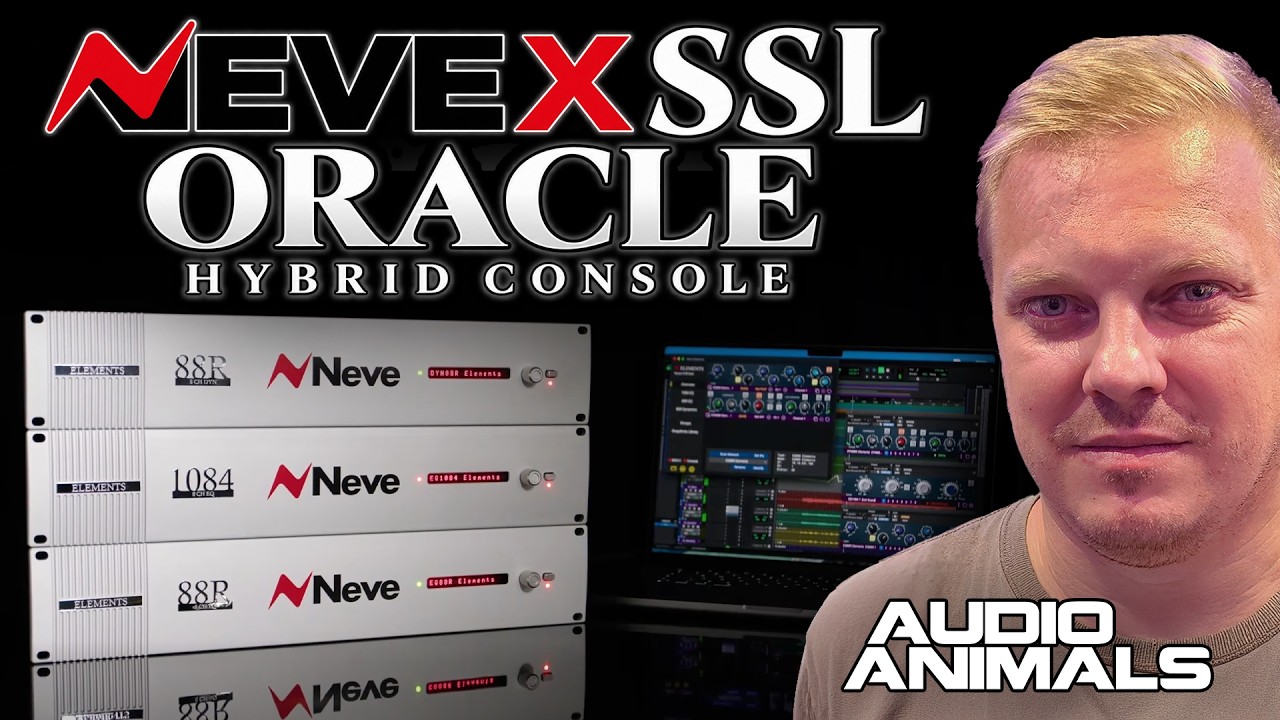
Neve Elements Could Change the Way We Build Analogue Consoles
The announcement of Neve Elements is particularly interesting because it makes digitally recallable analogue EQ and dynamics available in a modular format at a price that I believe is extremely competitive.
We're talking about the possibility of adding eight channels of Neve processing for roughly £4,000, depending on the module and final pricing. When you start calculating the cost of building a large multichannel analogue system, that becomes very attractive.
And that is exactly why I've been so interested in this range.
What Is Neve Elements?
Neve Elements introduces a new approach to accessing analogue processing, with three particularly interesting options: the 1084 EQ, the 88R EQ and the 88R dynamics.
These are exactly the kinds of processing options I'd love to have available across a large-format mixing console. Neve EQ has a distinctive character, and having that alongside 88R dynamics within a digitally recallable workflow opens up some exciting possibilities.
What makes the Elements concept especially appealing is the focus on software control rather than filling every module with physical knobs and switches. Removing those controls can reduce manufacturing costs while still providing access to professional analogue circuitry.
For some engineers, the lack of traditional hands-on controls will be a disadvantage. Personally, it doesn't bother me. I've already moved towards a workflow that combines analogue equipment with digital control, and I'm perfectly comfortable adjusting hardware from a computer or mapped controller.
Neve 1084 EQ
Classic Neve-style equalisation that could provide a different tonal character from my existing SSL processing.
Neve 88R EQ
Another equalisation option for building an extensive multichannel Neve processing system alongside the SSL Oracle.
Neve 88R Dynamics
Analogue dynamics with digital recall, offering the possibility of expanding the console's compression options.

Why I've Kept Quiet About Neve Elements
One of the reasons I've been looking forward to making this video is that I've known about Neve Elements long before the public announcement. I signed an NDA, which meant I couldn't discuss what was being developed.
I've had the opportunity to experience the equipment, and my initial impressions have been extremely positive. It sounds incredible, and the overall concept is exactly the sort of thing I've wanted manufacturers to develop.
I've also been fortunate enough to have discussions with manufacturers about the way engineers actually use digitally recallable analogue hardware.
Things like plug-in control, session recall, integration with existing studio equipment and the ability to move between different projects efficiently are incredibly important.
These are features that might not always be obvious until you're working with large quantities of hardware every day.
That's why I find it exciting when manufacturers listen to engineers and develop products around real studio workflows.
Why I Chose the SSL Oracle Over the SSL Odyssey
When SSL introduced the Odyssey console, I received quite a few questions asking why I hadn't chosen that instead of the Oracle.
What some people didn't realise was that Nick and I had already committed to a second SSL Oracle console for Studio A.
SSL invited us to see the Odyssey before its launch and gave us the opportunity to consider changing our order.
We looked at the additional features, the physical size and, most importantly, the difference in cost.
From our particular position, making the change would have required approximately another £100,000 on top of what we'd already spent. Naturally, that made us examine what we would actually gain for the additional money.
The Odyssey offered additional channel processing and other features, but I already had extensive digitally recallable EQ and compression available through my Oracle and WesAudio equipment.
For my particular requirements, I wasn't convinced the additional investment made sense.
The size of the console was also important. One of my favourite things about the Oracle is how accessible everything feels. I can remain seated in the middle of my monitoring position and reach the controls without constantly moving around.
In a carefully designed studio, keeping my head in the listening sweet spot is something I value enormously.
I didn't choose the SSL Oracle because I couldn't have an Odyssey. I chose it because it was the console that made the most sense for the system I wanted to build.

The Cost Difference Is Difficult to Ignore
When we were considering the Odyssey, I kept coming back to the same question: how much would we effectively be paying for the additional processing we wanted?
From our perspective, the upgrade worked out at approximately £100,000 for the additional capabilities we were interested in. When I broke that down against roughly 24 additional channels, the effective cost was over £4,000 per channel.
Now compare that with the approach I'm considering using Neve Elements.
Based on the indicative pricing I discussed in the video, I was estimating that eight channels of Neve 88R dynamics could cost around £4,000 to £5,000, excluding any additional system requirements.
That would put 24 channels of dynamics in the region of £15,000, based on those early estimates.
Naturally, those figures are not a direct like-for-like comparison between two complete consoles. There are other features, differences in equipment and installation costs to consider.
But when the objective is to add specific analogue processing to an already capable console, modular equipment starts to look extremely attractive.
Odyssey Upgrade
Approximately £100,000 additional investment in our situation, based on the upgrade we were offered.
A larger console with additional facilities, but not necessarily the direction I wanted for my studio.
Neve Elements Expansion
An estimated £15,000 for 24 channels of 88R dynamics, based on the provisional pricing discussed in the video.
A modular way to add Neve processing to the existing SSL Oracle system.
My Plan: An SSL, Neve and WesAudio Hybrid Console
This is the part I'm really excited about. Instead of replacing the Oracle, I want to develop it into an even more powerful digitally recallable analogue console.
My proposed configuration would combine 24 channels of SSL EQ with 24 channels of WesAudio dynamics on one section, then use another 24 channels for Neve EQ and dynamics processing.
That gives me the precision and flexibility of SSL processing, the tonal character of Neve and the additional capabilities offered by WesAudio.
What makes the plan especially interesting is that I don't necessarily want all 24 channels of EQ to be identical.
I'd like to retain some WesAudio Hyperion EQ channels while introducing a mixture of Neve 1084 and 88R EQ.
That means I could choose the character and processing approach that works best for each source rather than having exactly the same EQ across every channel.
It's a very different way of thinking about a large-format mixing console, and it's the reason I've spent so much time exploring digitally recallable hardware.
SSL Processing
SSL summing and EQ provide the precise, clean and familiar console workflow that I already enjoy using.
Neve Processing
Neve 1084 and 88R EQ alongside 88R dynamics would add another set of analogue processing choices.
WesAudio Processing
Existing digitally recallable modules, including Hyperion EQ and dynamics, add further flexibility and features.

Flexible EQ and Compression Routing
One feature that particularly interests me is the insert arrangement on the Neve 88R dynamics module.
The idea is that I can connect an EQ into the dynamics signal path and choose whether that EQ sits before or after the compressor.
That might sound like a relatively small feature, but it makes a big difference when you're designing a system with multiple channels of different analogue equipment.
Being able to change the processing order provides another useful option without having to physically repatch everything.
I can imagine combining Neve dynamics with a Hyperion EQ for one source, using a 1084 EQ on another and selecting the 88R EQ when that character works better.
It's this level of flexibility that makes the hybrid console concept so appealing.
Imagine having SSL EQ and summing, Neve EQ and dynamics, and WesAudio processing all available within one instantly recallable analogue mixing environment. That's the console I'm working towards.
Why Digital Recall Matters So Much to Me
I've spoken about digitally recallable analogue equipment many times because I genuinely believe it represents an important direction for professional studios.
I love analogue hardware, but I don't want to spend my day manually recalling hundreds of controls every time I open a different Pro Tools session.
I want to be able to move between jobs, open a project and have my hardware recall the settings that belong to that session.
That makes a huge difference when you're running a busy mixing and mastering business and working with multiple clients.
Companies such as WesAudio and Bettermaker have already made substantial progress in this area, and I'm pleased to see Neve entering the market with Elements.
For me, the more manufacturers that develop digitally controllable analogue products, the better. Greater choice means more possibilities for engineers designing their own studio systems.
Do Analogue EQs Really Need Physical Controls?
One thing that will divide opinion with Neve Elements is the decision to minimise conventional front-panel controls.
Some engineers want every analogue equaliser and compressor to have its own dedicated controls. I completely understand that.
Personally, I'm happy using a software interface when it gives me the benefits of analogue processing and reliable recall.
The hardware is still doing the analogue processing. You're simply changing the way its settings are controlled.
In my studio, I'm already comfortable working with digital control surfaces and computer-based adjustment.
If software control allows manufacturers to make professional analogue equipment more affordable, I think that's a positive development.
The important thing is how well the equipment integrates with the rest of the studio.
What's Next for Neve Elements at Audio Animals?
I'm expecting to receive Neve Elements hardware for the studio, including the 1084 EQ and 88R processing modules.
Once I've got the equipment installed, I'll be able to explore the workflow, the available routing options and how well everything works alongside the SSL Oracle and our existing WesAudio system.
I'll also be looking closely at how the plug-in control works, how settings are recalled and how practical the system is when moving between different mixing sessions.
I'm particularly interested in what this could mean for engineers who want the benefits of analogue processing without sacrificing the convenience of digital recall.
I've already heard the equipment and I'm impressed by what Neve has developed. Now I'm looking forward to exploring the finished system within my own studio workflow.

My Final Thoughts on Neve Elements
For me, Neve Elements is a genuinely exciting announcement. The combination of analogue processing, digital recall and an accessible modular format has enormous potential.
It also explains why I made the decision to keep the SSL Oracle rather than spend substantially more money moving to the Odyssey.
I wasn't simply choosing between two SSL consoles. I was thinking about the complete system I wanted to build over time.
Combining SSL summing and EQ with Neve dynamics and equalisation, alongside my existing WesAudio hardware, could give me exactly the workflow and sonic flexibility I've been looking for.
I believe Neve Elements will encourage more manufacturers to take digitally recallable analogue equipment seriously. Companies that have already embraced this technology have shown just how valuable it can be.
It's an exciting time for analogue audio engineering, and I'm looking forward to seeing how far this technology develops.