


If I had to build a recording studio from scratch again, with a budget of £10,000, I would spend almost all of that money on the listening environment. Forget expensive compressors, EQs and mixing consoles. My priorities would be the room, the speakers and the converters.
After years of building Audio Animals into the studio it is today, one of the biggest lessons I've learned is that the quality of what you hear is far more important than the amount of equipment you own.
If I were starting again with absolutely nothing, I'd happily sit in a comfortable chair, at a desk, with a good computer, a quality audio interface and a pair of exceptional monitors in a properly treated room.
I wouldn't need racks full of analogue equipment. I wouldn't need a large-format console. I'd be perfectly happy working with stock plug-ins because I know that, in a great listening environment, you can achieve genuinely excellent results.
Where I'd spend the money:
Watch: If I Built A Studio From Scratch, Where Would I Start?
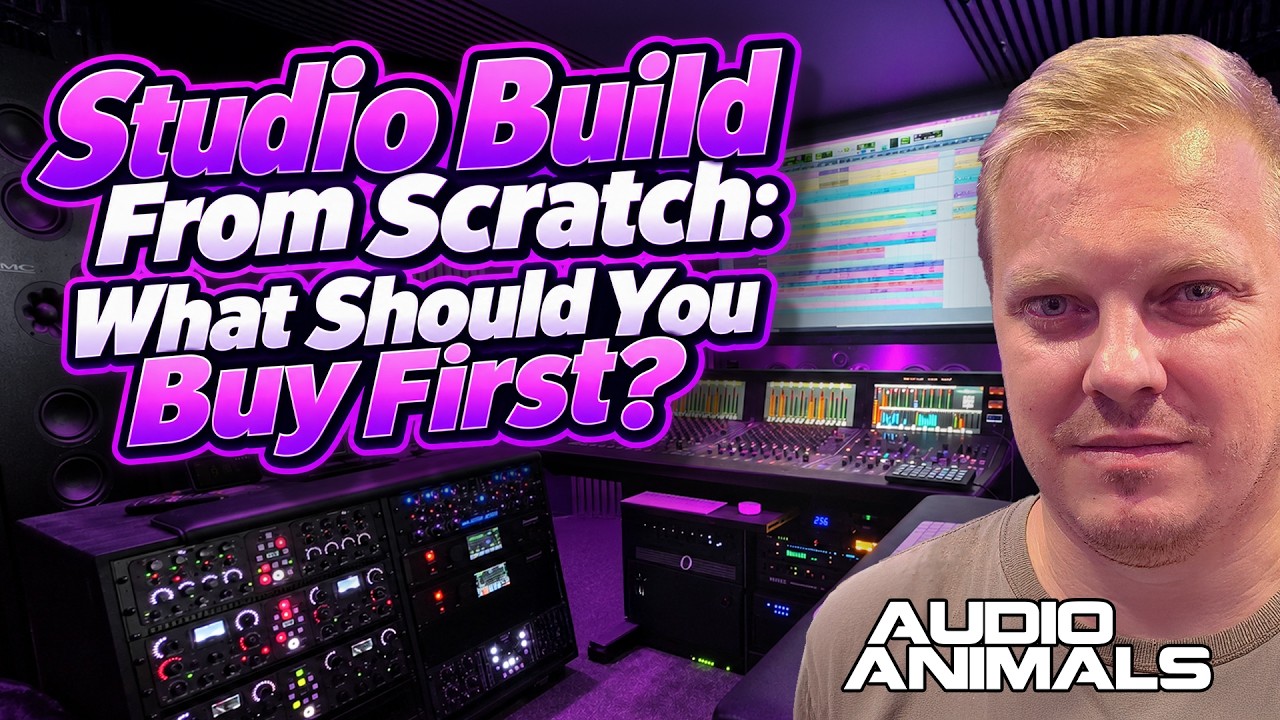
The Most Important Investment Is What You Hear
I genuinely believe that anybody who knows what they're doing can walk into an excellent listening environment, use relatively basic processing tools and produce a great-sounding mix.
The reason is simple: when you can accurately hear what's happening in your music, you can make better decisions.
It sounds obvious, but it's something that can easily be forgotten when you're surrounded by incredible analogue equipment and constantly looking at what you could buy next.
You can own the most expensive compressors, EQs and mixing consoles available, but if you cannot accurately hear what those processors are doing, you're already at a disadvantage.
The Mistake I Made Earlier In My Career
If you had asked me this question around ten years ago, my answer would probably have been very different.
Back then, I was far more interested in accumulating equipment. I had speakers, I had a studio, and my attention was largely focused on buying more and more analogue gear.
I think that's a trap a lot of engineers fall into. You see an amazing compressor, a beautiful EQ or a huge mixing console and naturally want to own it. That equipment is exciting. It's tangible. It looks incredible in a studio.
Meanwhile, the speakers and room acoustics can become an afterthought, even though they arguably deserve the most attention.
Looking back, I would reverse those priorities completely.
“I'd rather have a brilliant room and brilliant speakers with stock plug-ins than a room full of expensive equipment that I can't accurately hear.”
Why The Listening Environment Changes Everything
Today, I'm fortunate enough to work in an incredible listening environment at Audio Animals.
We have invested heavily in our rooms, monitoring systems, converters and acoustic treatment. Our monitoring environment also benefits from Trinnov optimisation, allowing us to achieve a level of accuracy that makes an enormous difference to the decisions we make.
I cannot overstate just how important that environment has become to my work.
I know that the results I achieve are directly influenced by how accurately I can hear the music. I can identify problems, make subtle adjustments and understand precisely what my processing is doing.
Without that level of monitoring, even having access to all the equipment in our studio wouldn't guarantee the same results.
Even The Best Equipment Cannot Fix A Bad Listening Environment
Imagine taking all the analogue equipment we have at Audio Animals, including our consoles, compressors and mastering processors, and putting it into a poorly treated room with inaccurate speakers.
Would I achieve the same results? I genuinely don't believe I would.
I could even challenge myself by disabling our Trinnov optimisation, deliberately setting up the speakers badly, or replacing our monitoring system with something significantly less accurate.
I would still be the same engineer, using the same equipment and making the same creative decisions. But the information reaching my ears would be compromised.
That's the problem. You cannot make consistently accurate decisions about things you cannot properly hear.
“Trying to mix in a bad room is like asking me to mix in our studio with cotton wool stuffed in my ears. I'm still the same engineer, but I can no longer hear what I need to hear.”
How I'd Spend A £10,000 Studio Budget
So, let's imagine I'm starting again with absolutely nothing and I have £10,000 to build a studio.
My first thought would be to spend as much as possible on the speakers, acoustics and conversion. But I would still need a computer, interface and somewhere to work. The following is roughly how I would divide that budget.
These aren't fixed rules or specific product recommendations. They are simply an example of how I would prioritise the investment.
Studio Monitors
I'd put around 25% of my budget towards the best monitoring system I could justify. The speakers are one of the most important parts of the entire studio.
Room Acoustics
Another 25% would go towards acoustic treatment, materials and improving the room itself. I'd aim to create the most accurate listening environment possible.
Computer
I'd buy a reliable, powerful computer, something along the lines of a capable Mac Studio, that could comfortably handle demanding audio sessions.
Audio Interface
I'd budget around £1,000 for a quality audio interface, paying particular attention to its digital-to-analogue conversion and monitoring performance.
What About The Remaining £2,000?
I'd keep the remaining budget available for the practical essentials: a desk, a comfortable chair, monitor stands, cables, software and anything else required to make the studio usable.
I might also consider a DAW controller if the budget allowed. I enjoy having physical control over a session, but I wouldn't consider it more important than the listening environment.
If I could save money on furniture or other non-essential equipment, I'd be tempted to put that money back into the speakers or the acoustics.
Why I'd Invest In Building The Room Properly
Something people often overlook is that the studio itself can be one of your most valuable investments.
At Audio Animals, our studio construction has been taken extremely seriously. One of our rooms is effectively floating on springs, with a level of structural isolation and acoustic design that makes it an exceptional environment to work in.
If I were starting again, I'd look at creating a properly designed room-within-a-room where practical and where isolation was necessary.
Now, there is a big difference between buying materials and paying professionals to build an entire studio for you.
Depending on the space, scope and design, I think a relatively modest self-build project could be achievable with a materials budget of a few thousand pounds. But once you start bringing in professional contractors, the costs can increase dramatically.
I would encourage anybody considering this approach to learn as much as possible about acoustic construction before spending money. Effective sound isolation and an accurate listening environment require careful design, and they are not necessarily the same thing.
Acoustic Treatment
Proper treatment helps control unwanted reflections, resonances and other acoustic problems that interfere with accurate monitoring.
Sound Isolation
Structural isolation can help reduce sound transmission between the studio and its surroundings, provided the construction is properly designed.
Speaker Placement
Correct monitor positioning and listening geometry are crucial for getting the best possible performance from your speakers.
Don't Neglect Your Audio Converters
One thing I would pay particular attention to is the quality of the audio interface and digital-to-analogue conversion.
You can spend thousands of pounds on exceptional speakers and build an excellent room, but you still need a reliable interface and a monitoring chain that allows those speakers to perform properly.
I'm not saying that an affordable interface such as a Focusrite Scarlett 2i2 is bad. Far from it. These interfaces can be excellent for the money.
But if I were investing heavily in a high-end monitoring environment, I would also want to assess the quality of the conversion, analogue output stages, operating levels and monitoring functionality.
My aim would be to build a well-balanced system rather than spending nearly everything on one component and overlooking the others.
“You're only as good as the weakest link in your monitoring chain. I'd want the room, speakers and converters to complement each other.”
A Reliable Computer Is More Important Than Another Compressor
There's nothing more frustrating than trying to work on a mix when your computer is constantly struggling.
Sessions hanging, plug-ins taking forever to load, playback stopping or the system running out of processing power can completely interrupt your creative flow.
That's why I'd also set aside a sensible amount for a good computer.
Something like a properly specified Mac Studio would be an attractive option. I wouldn't necessarily need the most expensive configuration available, but I'd want a system capable of handling demanding sessions reliably.
If the computer works properly, the monitoring is accurate and the room sounds excellent, you're already in a very strong position.
Why I Wouldn't Buy Analogue Outboard Gear Initially
This might sound strange coming from somebody who has spent years building a studio full of analogue equipment, but I wouldn't rush out to buy any of it.
I wouldn't immediately buy an expensive compressor, a mastering EQ or a large mixing console.
I'd start with a good DAW and the stock plug-ins available to me.
Because if I can hear exactly what I'm doing, I can make excellent decisions using relatively simple tools.
Once the studio was established, work was coming in and I had a clearer understanding of what additional equipment would genuinely improve my workflow, then I'd start looking at analogue hardware.
That approach makes far more sense to me than filling a room with expensive equipment before getting the fundamentals right.
What I'd Prioritise And What I'd Leave Until Later
Essential From Day One
Accurate monitoring, proper acoustic treatment, reliable audio conversion, a capable computer and a comfortable working environment.
These are the things that would help me produce consistent, professional results from the very beginning.
Equipment That Can Wait
Large-format consoles, expensive analogue compressors, specialist mastering EQs, extensive outboard racks and luxury control surfaces.
I'd gradually invest in these once the listening environment was established and there was a genuine reason to own them.
So, If I Started Audio Animals Again, What Would I Do Differently?
I'd spend less time worrying about all the beautiful analogue equipment I wanted to own and much more time thinking about the environment I was going to work in.
I'd buy the best monitoring system I could justify, invest properly in the acoustics, choose good converters and make sure I had a reliable computer.
Everything else could come later.
Over the years, I've gradually experienced just how much difference an exceptional listening environment makes. It's not something you can easily appreciate until you've spent time working in a genuinely accurate room.
The expensive equipment we have at Audio Animals is fantastic, and I love working with it. But I would not sacrifice the quality of our room or monitoring system just to have more gear.
If I had £10,000 and was starting from absolutely nothing, I'd build the foundations properly.
Because ultimately, the better you can hear your music, the better equipped you are to make the decisions that matter.