


SSL Fusion vs Rupert Neve Designs MBT vs Wes Audio NG OmniBox: three analogue bus processors, three different approaches, and one clear winner for the way I work.
I've owned three SSL Fusions, I own two Rupert Neve Designs MBTs, and I've recently added the Wes Audio NG OmniBox to my setup. I've spent time working with these processors, so I wanted to explain where I think each one excels, where it falls short, and which one I would buy if I had to choose.
This isn't a laboratory shootout or a blind audio comparison. I'm sharing my experience and opinion of the features, sound and practical workflow. I don't currently have a Fusion for direct audio demonstrations, but I intend to explore audio comparisons in a future video.
Watch: SSL Fusion vs MBT vs NG OmniBox
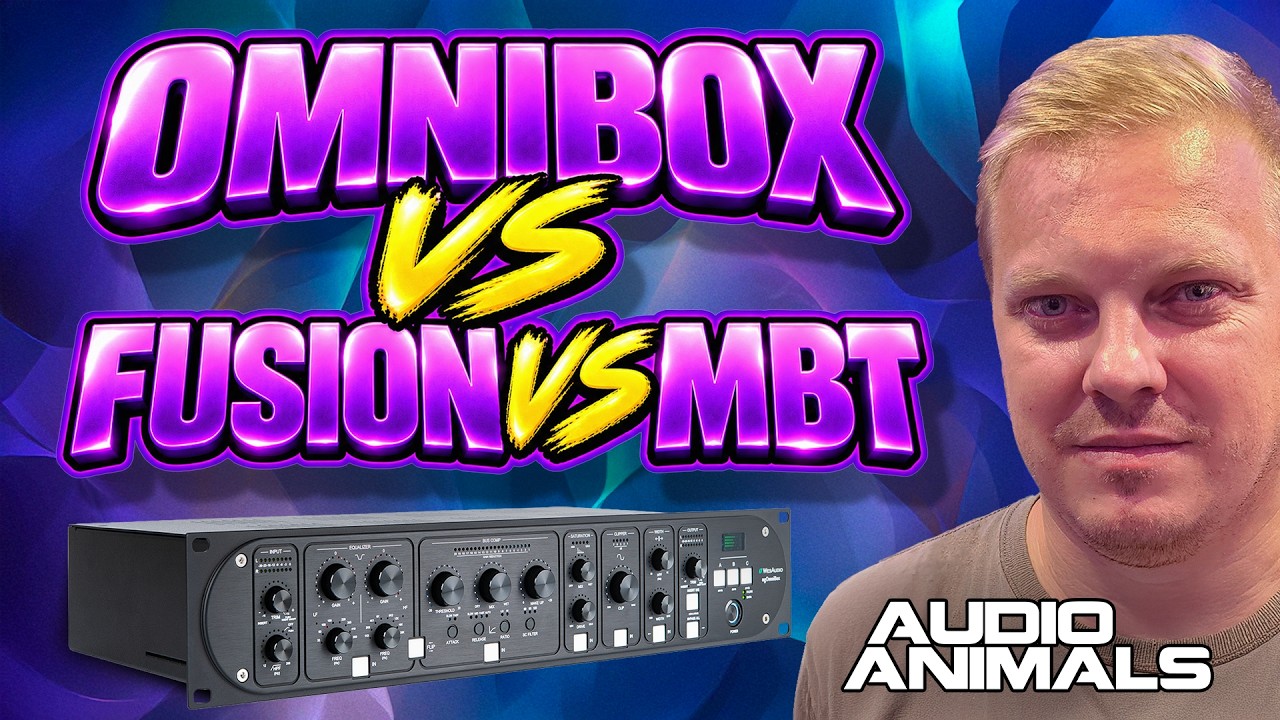
Before You Buy, Ask Yourself What You Actually Need
All three units are designed to give you several processing options in one box. But they aren't at the same price point, and they aren't necessarily aimed at the same customer.
The Fusion is the affordable way into this style of analogue processing. The MBT is the one I'd look at for its beautiful Super Silk colour. The OmniBox gives me a broader set of tools and the recall workflow that matters so much in my studio.
Rather than declaring one piece of gear better on every individual feature, I think it's more useful to understand what you're buying it for.
Three Boxes, Three Different Strengths
SSL Fusion
The accessible all-rounder
A little bit of everything, useful stereo processing and an excellent mid/side insert. I think it's one of the best starting points for building a mastering chain.
Rupert Neve Designs MBT
The colour specialist
For me, Super Silk is the reason to own one. Gorgeous saturation and classic analogue character, even if I don't use every other processing section.
Wes Audio NG OmniBox
My preferred all-in-one processor
A genuinely useful VCA compressor, analogue clipping, flexible inserts, width control and complete digital recall make it the most attractive choice for me.
SSL Fusion: Still Incredible Value for Money
I've said this many times: I think the SSL Fusion is one of the best pieces of hardware you can buy when you're starting a mastering chain. It gives you a little bit of everything in one reasonably affordable unit.
When I bought mine, they were around £1,800. I've since seen used units at considerably lower prices, sometimes under £1,000 in the UK. That's a lot of functionality for the money, especially with the mid/side insert.
My view of the individual sections is that they're generally good without necessarily being exceptional. The shelving EQ is clean and useful, the stereo width and depth processing are very nice, and the high-frequency compressor does its job, although it wasn't something I used very often.
The Vintage Drive was less convincing for me. On the units I owned, I found the noise level too high to comfortably use in mastering. I can't say whether newer units behave the same way, but that was my experience.
Where the Fusion really earns its place is its versatility. The mid/side-capable insert lets you bring another dual-mono processor into a mid/side chain, something that would otherwise require additional routing or hardware. Even if I eventually stopped using the Fusion's other sections, that insert alone would remain useful.
It's not the most sophisticated processor of the three, but at its price, I think it's brilliant.
Rupert Neve MBT: Super Silk Is the Star
I own two Rupert Neve Designs MBTs, and the reason I value them is very simple: Super Silk. That's what makes this unit special for me.
I love what the saturation does. The Red and Blue Silk controls let me shape upper- and lower-frequency harmonic character, and I think that sound is phenomenal.
There are other useful sections. The EQ and filter do their jobs, the stereo width is nice, and the opto-style Color Comp has applications, particularly on sources such as vocals. But it isn't the compressor I'd personally choose as the centre of my mastering bus.
That's where the cost becomes difficult for me to justify. When I'm mainly reaching for the Silk and occasionally the width, it's an expensive way to access those two features. I also think the lack of an external insert is a missed opportunity compared with the Fusion.
None of that takes anything away from the sound of the MBT. If the signature Rupert Neve saturation is your priority, this is the one I'd encourage you to explore.
Wes Audio NG OmniBox: The Most Complete Package for Me
I'll admit I'm still in the honeymoon period with the OmniBox. But what has impressed me is how much useful processing Wes Audio has put into one unit, and how well those sections work together.
It's a jack-of-all-trades style of processor, and I don't expect its EQ to replace every dedicated mastering EQ or its compression to replace every specialist compressor. However, compared directly with the Fusion and MBT as all-in-one processors, I think the OmniBox comes out ahead.
The shelving EQ sounds beautiful and remains relatively clean to my ears. I'd love to compare it with my Wes Audio Hyperion in more detail. The VCA bus compressor is the more useful option for my workflow than the MBT's opto compressor or the Fusion's high-frequency compressor; it reminds me of the kind of bus compression I enjoy from the Wes Audio Dione.
Then there's the analogue clipper. I recently used it on drums to gently catch snare peaks rather than aggressively flatten the signal, and it worked beautifully. The saturation is also good, especially with the drive and mix controls, although for subtle mastering saturation I still prefer the MBT's Silk.
How I Compare the Main Sections
Filters and EQ
I don't hear a decisive winner in the filters. The MBT and OmniBox EQs feel more premium to me, while the Fusion EQ is very clean. All three cover useful shelving duties.
Compression
The OmniBox wins for my purposes. Its VCA compressor makes far more sense for the mix bus than the MBT's opto stage or the Fusion's high-frequency compressor.
Stereo Width
I wouldn't call one an outright winner. The Fusion's width and depth are lovely, the MBT can focus widening above a chosen frequency, and the OmniBox takes a different approach to low-frequency stereo information.
Saturation
The MBT wins this category for me. Super Silk has a special quality. The OmniBox is versatile and can sound fantastic on guitars, but I prefer the MBT for subtle colour in mastering.
The Stereo Width Difference Is Important
One thing that initially caught me out on the OmniBox was its low-frequency treatment in the width section. In my testing, setting that frequency behaved more like a mono-maker or elliptical filter: stereo information below the chosen point was reduced, while I could enhance the width above it.
The MBT, as I use it, feels different. I can set a frequency region above which I want to widen the signal without deliberately collapsing the low end in the same way. Neither approach is automatically better, but they produce different results and you need to understand what the control is doing.
I'd love to see Wes Audio offer a switchable option in the OmniBox so I could choose between the low-frequency mono-making behaviour and a crossover-based widening approach. Whether that could be implemented in firmware is something I'd like to ask them.
Why the OmniBox Inserts Are Such a Big Deal
The Fusion has a brilliant external insert with mid/side capability and a choice of insert positions. The MBT doesn't offer the same facility. The OmniBox surprised me by providing two insert points: a stereo insert at the input and a mid/side-capable insert at the output.
That means I can connect additional hardware both before and after the OmniBox's internal processing. Unlike the Fusion, I can't freely move these insert points into the middle of its processing path, but having access to both ends of the unit is extremely useful.
I've put my HUM Audio LAAL limiter on the output insert, alongside a Wes Audio NG Leveler for recallable gain control. By linking the gain changes, I can raise the level going in while compensating on the way out. Crucially, I can also recall the insert bypass from the OmniBox.
For my studio, that gives me a much more convenient way to integrate non-recallable analogue equipment into a recall-driven setup. The OmniBox also lets me change whether EQ comes before or after compression, which opens up further possibilities for processing order.
Digital recall isn't just about remembering the knobs on one box. It's about making an entire analogue workflow faster, more flexible and easier to revisit.
Digital Recall Is the Future of Analogue Hardware
My main studio is built around digital recall. I want analogue sound without having to manually reset an entire rack every time I reopen a session. That's why I think hybrid hardware with software control is the best of both worlds.
Imagine using one OmniBox on a drum bus, printing the result, then moving it to a vocal bus and saving different settings. Later, you can reactivate the appropriate plugin instance, recall that processing and make a change without photographing every dial. It still requires sensible routing and printing, but the flexibility is enormous when you only own one unit.
This is also why I'd happily consider buying a digitally recallable SSL Fusion if SSL ever made one. I don't know whether they will. I simply think manufacturers who overlook digital recall are missing an important part of where professional studios are heading.
My Verdict: Which One Would I Buy?
On a tighter budget: I'd buy the SSL Fusion. It's flexible, sounds good and provides a very useful mid/side insert at a comparatively accessible price.
For beautiful analogue saturation: I'd choose the Rupert Neve MBT. Super Silk is its biggest selling point, and I genuinely love that character.
If money were no object and I could only choose one: I'd buy the Wes Audio NG OmniBox. Its compressor, clipper, inserts, stereo processing and, above all, digital recall make it the strongest all-round solution for my workflow.
That doesn't mean every engineer should make the same choice. Each unit has its place. But the OmniBox is the one that gives me the most useful combination of features and day-to-day flexibility.
I plan to put together a more detailed OmniBox review and further audio comparisons. For now, that's my opinion after owning and working with these processors. Which one would you choose for your studio?